

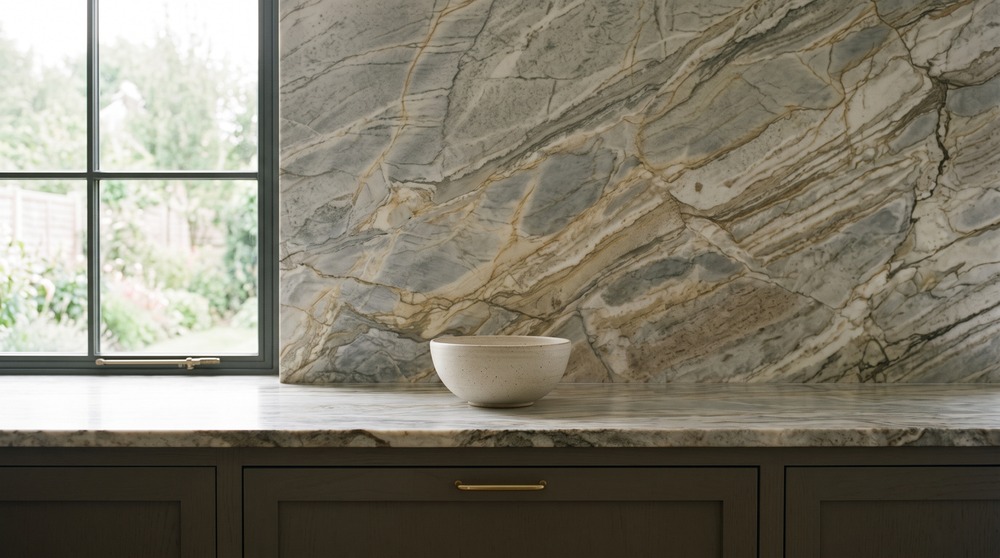
A quartzite slab with grey and gold movement can be the starting point for a beautiful kitchen. The next question is just as important: “What backsplash goes with it?” The answer depends on the stone’s colors, the scale of its veining, and how much attention you want each surface to attract.
Choosing the countertop first usually makes this decision easier, especially with natural stone. Each slab has its own pattern, while tile generally offers more repeatable options. This guide explains how to match countertops and backsplash, check undertones, and compare your choices before you commit.
Start With the Countertop, Not the Backsplash
Natural stone varies from slab to slab, even within the same block. Choosing your countertop slab first gives you a clear starting point for the rest of the kitchen. Manufactured tile usually offers more repeatable options, although availability and variation between batches still matter.
Choose your slab, then choose a backsplash that complements it. If you are still deciding on material, our beginner’s guide to choosing a countertop material is the place to start.
The Three Ways to Pair a Countertop and Backsplash
Most countertop and backsplash combinations follow one of three approaches. Choosing an approach early helps you compare materials with a clear direction.
1. Match it
The backsplash uses the same material as the countertop, usually run as a full-height slab from counter to upper cabinets. This creates a cohesive, modern look. With careful slab selection and layout planning, the veining can appear to continue up the wall.
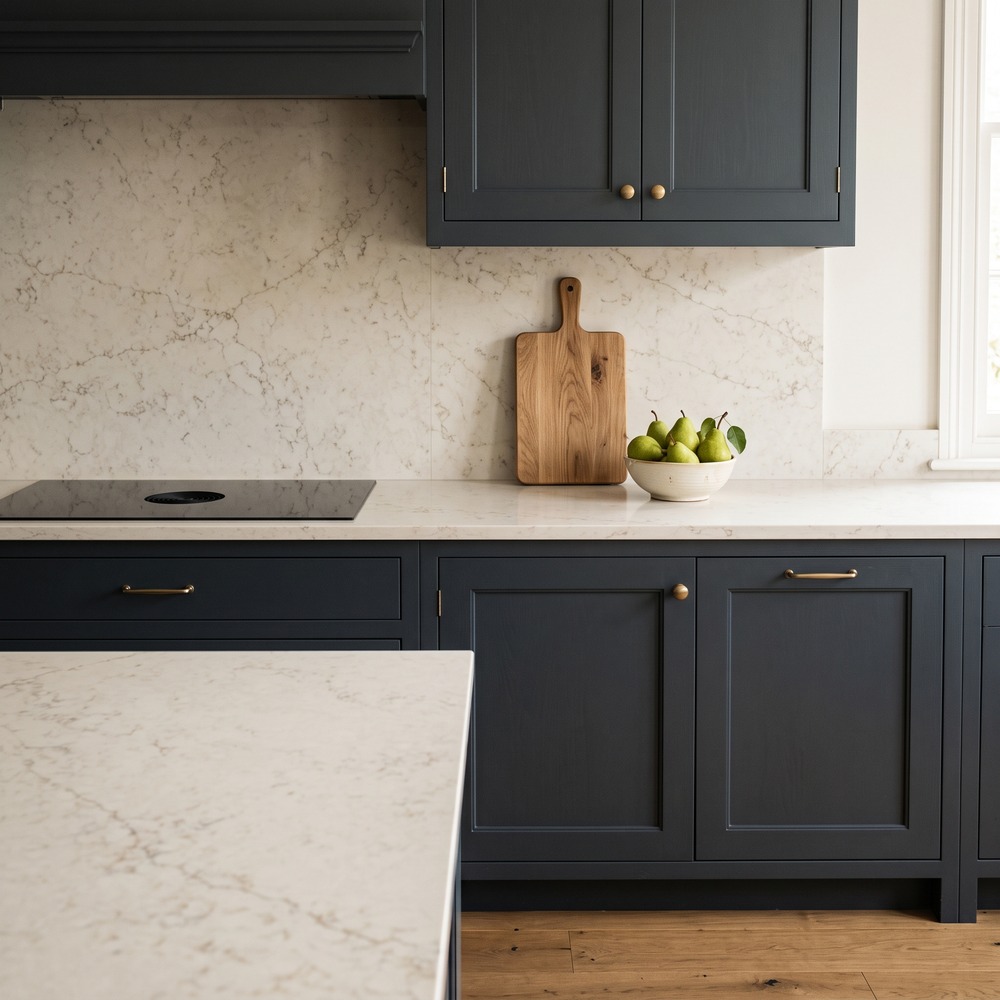
2. Complement it
The backsplash lives in the same color family as the countertop but changes scale, texture, or tone. A white quartz counter with a soft white zellige tile. A warm beige granite with a cream subway tile. The surfaces share a visual connection without looking identical.
This is often a practical approach for homeowners who want a cohesive kitchen without relying on a strong contrast or a distinctive pattern.
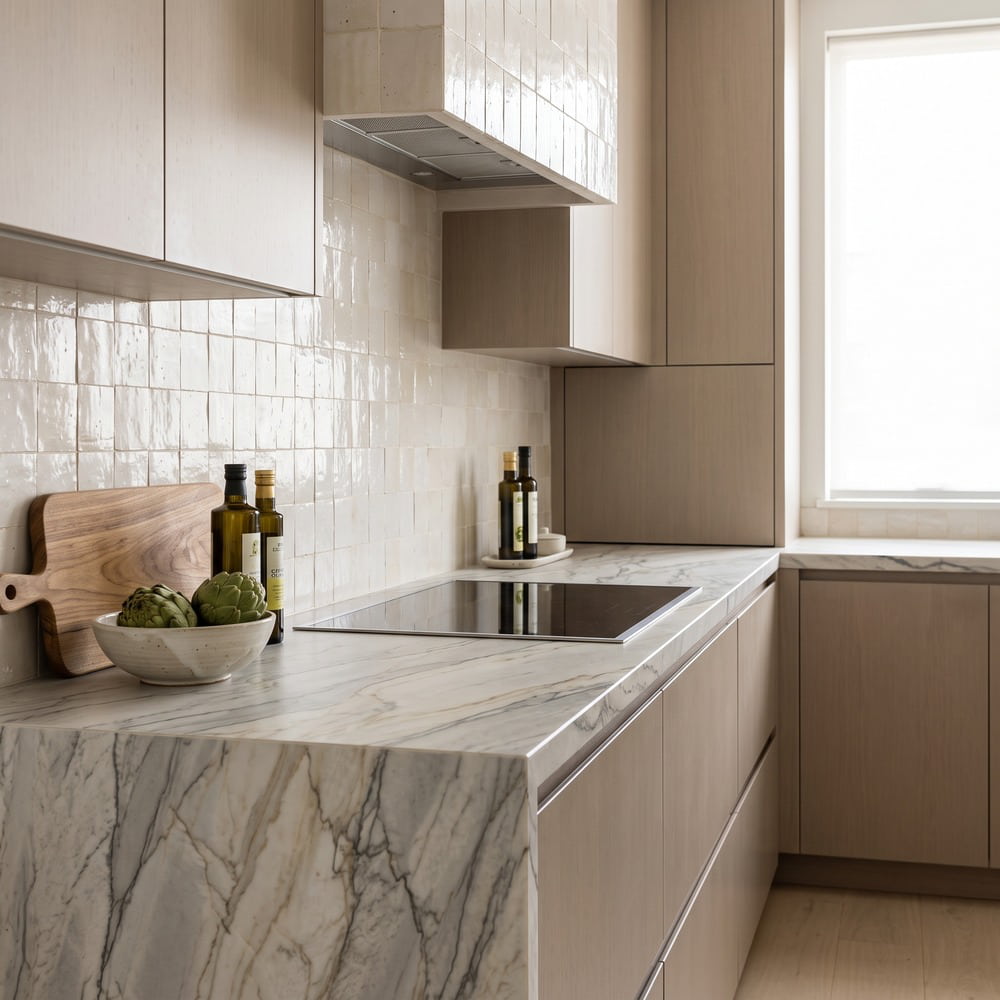
3. Contrast it
The backsplash deliberately contrasts with the countertop — a dark counter with a bright white tile, or a pale quartz with a deep green glazed tile. This approach can bring more personality to the kitchen, but the two surfaces still need a connection through undertone, texture, or the surrounding finishes.
| Approach | Best for | Watch out for |
|---|---|---|
| Match (full-height slab) | Dramatic stone, modern kitchens, minimal upper cabinetry | Cost; a very busy stone can overwhelm a small kitchen |
| Complement | A wide range of kitchens; a cohesive overall look | Subtle differences in undertone |
| Contrast | Solid or near-solid countertops; kitchens that need a focal point | Two busy surfaces competing for attention |
Let One Surface Lead
Choose which surface will be the focal point. This makes the remaining design decisions easier.
If your countertop has heavy movement — dramatic quartzite, Fantasy Brown, or a boldly veined marble — a quieter backsplash usually gives the eye somewhere to rest.
If your countertop is solid or near-solid — Absolute Black granite, a plain white quartz, or a soft grey with minimal veining — the backsplash has more room to carry the personality. This is where handmade tile, a pattern, or a saturated color can work particularly well.
Two visually busy surfaces can be harder to balance. A heavily veined countertop beneath a patterned tile may feel crowded unless their colors and pattern scales work together. If you have fallen for a statement tile, consider a calmer slab beneath it. In that design, the tile becomes the focal point and the stone supports it.
Matching by Countertop Type
Heavily veined stone
Quartzites with strong movement, Fantasy Brown, and dramatic marbles often pair well with a plain tile that picks up a secondary color in the veining. A grey-and-gold quartzite with a warm off-white backsplash, for example, can bring out the warmer details without competing with the pattern.
The alternative, if budget allows, is a full-height slab backsplash. When the stone is the focal point, continuing it up the wall can create a cohesive result. Read more about the material in our complete quartzite guide.
Solid or near-solid countertops
Absolute Black, plain white quartz, and solid greys generally give a backsplash more freedom. Pattern, texture, color, and handmade tile with visible variation can all work well when their undertones suit the rest of the kitchen.
Marble-look quartz
Marble-look quartz is a popular choice for a veined look, and it benefits from careful backsplash selection. When both surfaces have similar veining, the patterns can compete. Plain white or light grey tile often pairs well with softer quartz patterns, as does using the same quartz full height.
Warm-toned granite
Browns, golds, and warm speckled patterns often work well with cream, greige, soft taupe, or warm white. A cool grey or stark white backsplash can make the granite’s orange or golden tones appear stronger. See our granite buyer’s guide for more on reading granite’s tones.
Undertones: Where Pairings Can Go Wrong
If a pairing looks slightly off but the reason is hard to identify, undertones are a useful place to start.
White is not one color. A tile can be a cool blue-white, a warm cream-white, or a greige-white, and the difference can become more noticeable beside a slab. The same is true of grey: a blue-based grey and a brown-based grey may be harder to coordinate than they appear on a screen.
Use this simple sample test:
- Place the tile sample directly against the slab so you can compare the colors without a gap between them.
- Look at the combination in daylight, then under artificial light. Daylight changes with the season, weather, and window direction, so the same kitchen can look different throughout the year.
- Stand the tile upright beside the slab. A backsplash is a vertical surface catching light from a different angle, and a pairing can look different upright.
- If one surface suddenly looks dirty, yellow, or pink, that may signal an undertone clash. Grout and lighting can change the overall impression, but they usually will not resolve a strong mismatch on their own.
This is a good reason to bring tile samples to the showroom. Photos and screens do not always reproduce undertones accurately.
Full-Height Slab Backsplash vs. Tile
Both options can work well. The right choice depends on the look, budget, and installation plan.
| Consideration | Full-height slab | Tile |
|---|---|---|
| Look | Cohesive, modern; veining continuity depends on layout | Texture and pattern; wide stylistic range |
| Cost | Usually higher — more stone and fabrication | Generally lower; wide price range |
| Cleaning | Fewer joints to clean; care depends on the material | Grout needs periodic attention, especially behind the range |
| Material needed | May require an additional slab | Independent of slab inventory |
| Timeline | Coordinated with countertop fabrication; installation timing varies | Usually installed after the countertop |
| Outlets | Cutouts need to be coordinated during planning and measurement | Tile cuts around outlets are handled during installation |
If you want a full-height slab backsplash, discuss it before templating. It affects how much material is reserved, how seams are planned, and where outlet cutouts land. Adding it later can make finding matching material more difficult.
What about the 4-inch stone backsplash?
This is the short stone strip that matches the counter. It is a budget-conscious way to protect the lower wall and can suit a rental, basement kitchenette, or laundry room. For a main kitchen remodel, full-height slab or tile provides more coverage and a different visual effect.
Do Not Forget the Cabinets
Countertop and backsplash do not exist alone. They sit between cabinet fronts, and the cabinets usually occupy more visual space than either.
With white cabinets, the countertop and backsplash help determine whether the kitchen feels crisp or warm. With dark cabinets, a pale backsplash can help brighten the room while the counter connects the lighter and darker finishes.
A useful check is to look at all three surfaces together from a few feet away. If they blend more than you intended, consider adding contrast. If one immediately draws attention, make sure it is the surface you want to emphasize.
Common Mistakes to Avoid
- Buying tile before considering the slab. If natural stone is your priority, choosing it first usually gives you more flexibility.
- Matching too precisely. A tile that is almost the same white as the counter can highlight differences in undertone. Compare samples carefully, or choose a more deliberate contrast.
- Choosing from a screen. Photos and screens can distort undertones.
- Ignoring grout. On plain white tile, grout color changes the overall effect. Dark grout can turn a quiet backsplash into a visible grid pattern.
- Forgetting the range wall. This area deserves attention for both appearance and cleaning. A slab behind the range with tile elsewhere is one option.
- Leaving slab backsplash decisions too late. Full-height slab affects material quantities, fabrication, and installation planning.
- Judging under showroom lighting alone. Take samples to the actual kitchen and view them at the times you use the room most.
How to Test the Pairing Before You Commit
- Choose and reserve the slab.
- Take a well-lit photo for reference and note its dominant and secondary colors.
- Collect three to five tile candidates as physical samples.
- Compare them with the slab, both flat and upright, in daylight and under artificial light.
- Place the two best candidates against your actual backsplash wall at home for two or three days.
- Look at them in the morning and at night before you order.
Living with samples for a few days can reveal differences that a quick showroom visit misses.
Countertop and Backsplash FAQ
Should the backsplash match the countertop exactly?
No. Using the same material can create a cohesive look, but a complementary tile can work equally well. If you choose similar colors in different materials, check their undertones together in your kitchen.
Is a full-height slab backsplash worth the cost?
It can be, especially if you want to make the stone a focal point and reduce the number of joints to clean. Tile may offer more texture or pattern for a lower cost, depending on the product and installation.
Can I use a different stone for the backsplash than the countertop?
Yes, and it can look excellent. In most cases, the pairing is easier to balance when one stone has a quieter pattern. Two strongly veined stones need more careful coordination of color and pattern scale.
What backsplash goes with a busy granite?
A plain tile in one of the granite’s secondary colors is a useful starting point. Matching the dominant color can also work, but compare samples to make sure the combination has the balance you want.
Do I need to choose the backsplash before templating?
If you want a full-height slab backsplash, discuss it beforehand because it affects material reservation, seam planning, and outlet cutouts. Tile selection can often be finalized later, although comparing samples with the slab early usually makes the decision easier.
Should grout match the tile?
For a quiet backsplash, a close grout match helps the wall read as one surface. Contrasting grout is useful when you want to emphasize the tile shape or layout.
See the Stone Before You Choose the Tile
We keep over 4,000 full-size slabs in our indoor showroom in Bensenville, and comparing them with your tile samples can make the decision easier. Bring your cabinet door sample too if you have one — seeing the countertop, backsplash, and cabinet finish together helps you judge the kitchen as a whole.
Call 773-632-1600 or book an appointment. We serve Chicago and the surrounding 150-mile area.