

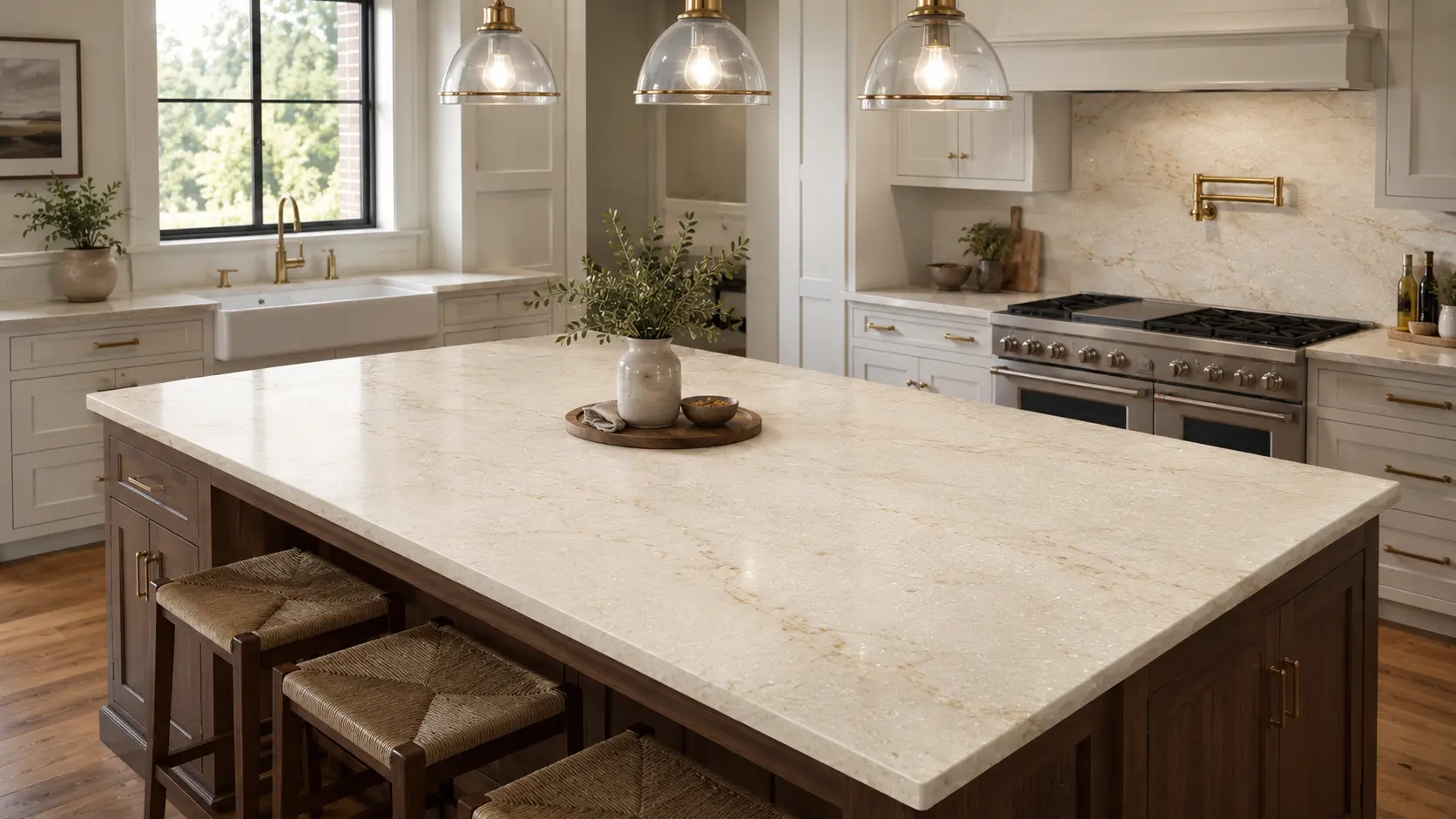
There’s a moment that happens in our Bensenville showroom about once a day. Someone walks in convinced they want marble, we walk them past the quartzite racks, and they stop.
It looks like marble. The veining moves the same way, the depth is the same, some slabs even have that faint translucence. Then we tell them a hot pan won’t hurt it and lemon juice won’t etch it, and the conversation changes completely.
Quartzite is the stone that solved a problem homeowners had been living with for decades: how to get the look of marble without the anxiety. Here’s the full picture — including the parts most showrooms don’t volunteer.
What Quartzite Actually Is
Quartzite starts as sandstone. Buried deep in the earth, under enormous heat and pressure over millions of years, the individual sand grains recrystallize and fuse into a single dense mass of interlocked quartz. The result is a metamorphic rock that is genuinely one of the hardest natural surfaces you can put in a kitchen.
Most of the quartzite in American showrooms comes from Brazil, with additional supply from India. It’s quarried, cut into slabs, and polished — and what you see is exactly what the earth made. No two slabs are identical, and no factory can reproduce them.
One clarification worth making early, because the names cause endless confusion: quartzite is not quartz. Quartz countertops are an engineered product — ground quartz mineral bound with resins. Quartzite is natural stone. We break the difference down fully in our quartz vs. quartzite comparison.
Why Chicago Homeowners Choose It
It’s harder than granite. Quartzite sits around 7 on the Mohs hardness scale; granite typically lands between 6 and 6.5. In practice this means knives don’t mark it. We tell customers to use cutting boards to protect their knives, not the counter.
Heat doesn’t bother it. It was formed by heat. A pan straight off the burner is a non-event. If you’re an aggressive cook who sets things down wherever there’s room, this alone rules out engineered quartz and rules in quartzite.
It doesn’t etch. This is the marble problem quartzite solves. Lemon juice, wine, vinegar, and tomato sauce leave dull spots on marble because the acid reacts with calcium carbonate. True quartzite is silica-based — acids do nothing to it. You get the marble look without the flinch every time someone opens a bottle of wine.
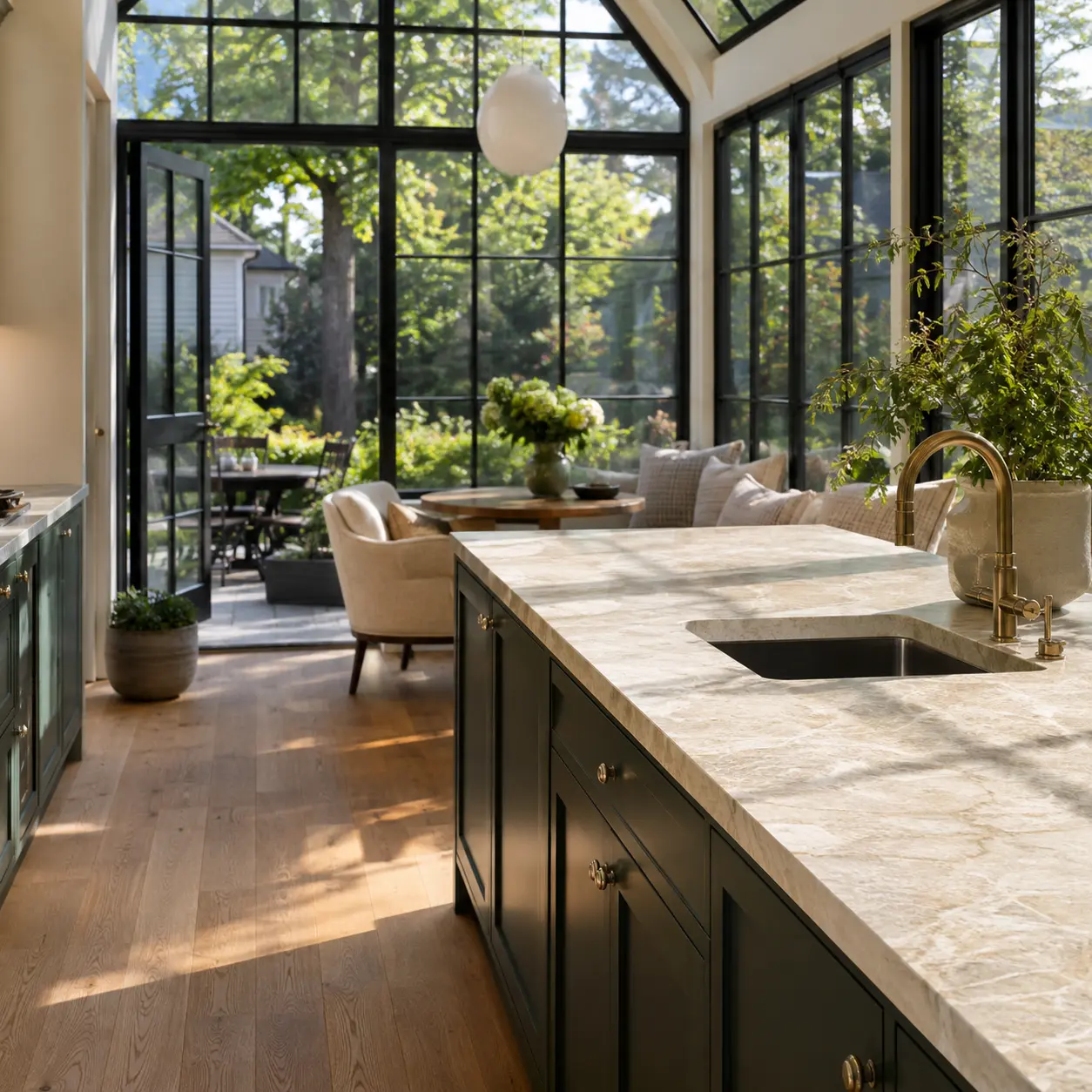
It handles UV and weather. Quartzite doesn’t fade in sunlight and stands up to Chicago freeze-thaw cycles, which makes it one of the few premium options that works in an outdoor kitchen or a sunroom.
Every slab is a one-off. For a large island — the piece everyone in the room looks at — that matters. This is why quartzite dominates the statement island category in high-end Chicago kitchens.
The Honest Trade-Offs
It’s porous, so it needs sealing. All natural stone is. Density varies a lot between quartzites — some dense slabs need sealing rarely, more absorbent ones want it annually. It’s a straightforward 20-minute job you can do yourself, but it does have to actually happen. Our granite and marble care guide covers the process, which is identical for quartzite.
It’s expensive. Quartzite starts roughly where mid-range quartz ends. That’s not markup — it’s supply. Rare natural slabs can’t be manufactured to meet demand.
Fabrication is harder and slower. Quartzite’s hardness chews through diamond tooling. Cutting takes longer, blades wear faster, and some shops add a surcharge or quietly avoid the material. Ask your fabricator directly how often they cut quartzite before you commit a $6,000 slab to them.
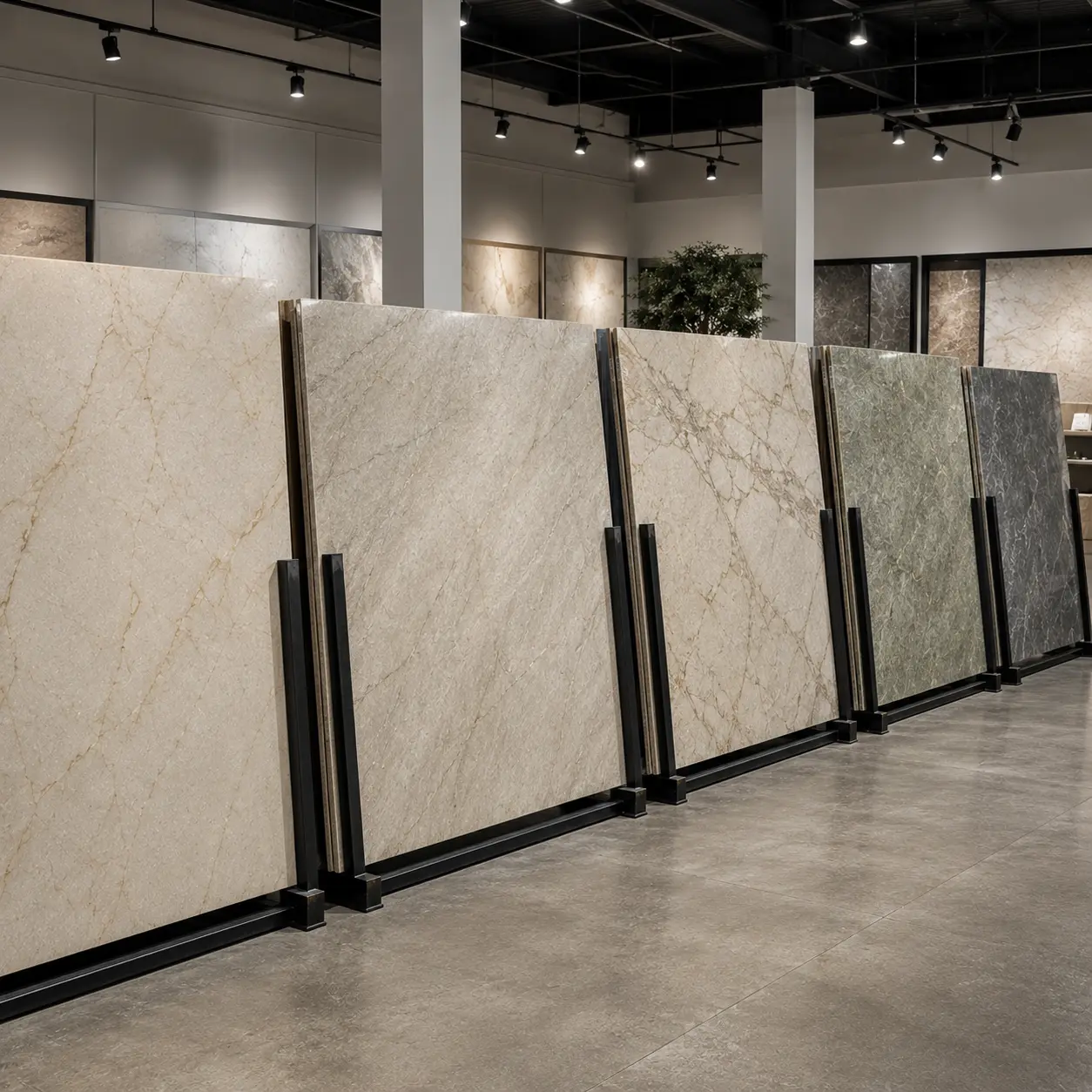
You have to see the actual slab. Because every slab is unique, choosing quartzite from a photo or a 4-inch sample is a mistake. You need to stand in front of the full slab, see where the veining runs, and understand how it will land on your island.
Some “quartzite” isn’t quartzite. This is the big one — next section.
The Soft Quartzite Trap
Some stones are sold under the quartzite label that are actually dolomitic marble. Fantasy Brown is the most common example, and Super White is another frequently misclassified stone.
These are beautiful materials. They are not, however, as hard as quartzite, and they etch from household acids the way marble does. If you buy one believing you’ve bought a bulletproof surface, you’ll be unhappy the first time someone leaves a lemon wedge on the counter overnight.
The test is simple: true quartzite will not etch from lemon juice, and a glass shard won’t scratch it. Any reputable fabricator will let you test a sample and will tell you straight what a stone actually is.
None of this means you shouldn’t buy a soft quartzite. It means you should know which one you’re buying.
Popular Quartzite Varieties
Taj Mahal. The most requested quartzite in our showroom, and for good reason — a warm creamy background with soft golden movement that flatters both white and wood cabinetry. Forgiving, versatile, and the safest entry point into the material.
Mont Blanc. Cooler and grayer, with fine linear veining. The closest thing to a Carrara look in true quartzite.
White Macaubas. Bright white with dramatic gray veining that runs in bold, confident lines. A statement stone for a statement island.
Sea Pearl. Green-gray with organic movement, often finished honed or leathered. Popular in transitional and organic-modern kitchens.
Perla Venata. Warm, subtle, gold-toned. Reads quieter than Taj Mahal.
Cristallo. The showstopper — translucent, crystalline, and expensive. Because light passes through it, Cristallo can be backlit, which is why it keeps appearing in luxury bars and islands across the North Shore.
Azul Macaubas. Rare blue quartzite. If you see it and fall in love, brace yourself for the number.
Finishes and Thickness
Polished is the default: reflective, deepens color, shows the veining most vividly. It also shows fingerprints and water spots more readily.
Honed is matte and soft, with a contemporary feel. It’s forgiving with fingerprints but slightly more open to staining, so sealing matters more.
Leathered or brushed has a subtle texture with a low sheen. Excellent at hiding smudges, and increasingly requested for islands and outdoor kitchens.
On thickness, 3cm is standard for kitchen counters in the Chicago market — strong enough to span cabinet runs without plywood substrate. 2cm shows up in bathroom vanities and in mitered-edge builds where a thicker profile is created by joining pieces.
What Quartzite Costs in Chicago
Installed pricing in the Chicago area typically runs $90 to $210 per square foot, covering material, fabrication, standard edge, one sink cutout, delivery, and installation.
For a typical 30-square-foot kitchen, that puts most quartzite projects in the $5,000 to $11,000 range. A large kitchen with an island and a waterfall edge in a premium stone will run higher.
For comparison, quartz runs $60–$150 and granite $55–$200 in this market. Quartzite starts near where mid-range quartz ends and climbs from there.
Four things move your number the most: the rarity of the stone, whether your layout requires a second slab, the edge profile, and building access. That last one is a real Chicago factor — a high-rise install with a reserved freight elevator and a certificate of insurance requirement costs more than a suburban ranch, same slab.
Caring for Quartzite
It’s genuinely simple. Wipe with warm water and a pH-neutral stone cleaner. Skip vinegar, bleach, ammonia, and abrasive powders — not because they’ll etch the stone, but because they degrade the sealer.
Seal it when it needs it, which you can check yourself: drop a tablespoon of water on the surface and wait fifteen minutes. If it beads, you’re fine. If it darkens the stone, it’s time to reseal.
Wipe up oil and wine reasonably promptly. Sealed quartzite resists staining well, but a sealer is a delay, not a force field.
That’s the whole regimen. Handled this way, quartzite outlasts almost everything else in the kitchen — see our countertop lifespan breakdown.
Is Quartzite Right for Your Kitchen?
Choose quartzite if:
- You want the marble look but can’t live with etching
- Hot pans land directly on the counter
- You want genuinely unique, one-of-a-kind natural stone
- It’s for a large island where the slab becomes the focal point
- You’re building an outdoor kitchen or a sun-filled room
- An occasional sealing session doesn’t bother you
Look elsewhere if:
- Your budget is firmly under $90 per square foot installed
- You want guaranteed consistency between slabs and samples
- You want a surface that never needs any maintenance at all
- You can’t visit a showroom to see the actual slab
FAQ
Is quartzite better than granite? Harder and generally more marble-like in appearance, yes. Granite offers a wider price range, more color variety, and a lower entry point. Both are heat-proof natural stones that need periodic sealing.
Does quartzite stain? It can if left unsealed and exposed to oil or wine for extended periods. Sealed quartzite resists staining well, and most stains that do occur can be lifted with a poultice.
How often does quartzite need sealing? It varies by slab density — anywhere from annually to every few years. The water test tells you more reliably than any schedule.
Can you put hot pans on quartzite? Yes. It’s natural stone formed under extreme heat and won’t scorch, discolor, or degrade from cookware temperatures.
Is quartzite worth the extra cost over quartz? If heat resistance, natural uniqueness, or outdoor use matter to you, yes. If you want zero maintenance and predictable pricing, quartz is the better value. Neither answer is wrong.
Does quartzite add resale value in Chicago? Premium natural stone is well recognized by Chicago buyers and appraisers. Quartzite reads clearly as an upgrade, particularly in higher-end homes on the North Shore and western suburbs.
How long does a quartzite project take? Most Chicago projects run one to three weeks from the template visit to installation, depending on slab availability and fabrication scheduling.
Come See the Slabs
Quartzite is the material that photographs least well and sells itself fastest in person. The depth, the translucence, the way veining moves across a full 10-foot slab — none of it survives a screen.
Browse our quartzite inventory online to shortlist a few, then visit our Bensenville showroom and see them at full size. We’ll show you where the veining will land on your island, tell you honestly whether a stone is true quartzite or a soft one, and let you test it yourself.
Call (+1) 773-632-1600 or make an appointment — bring your layout, leave with a slab you’ve actually stood in front of.
One Response
[…] The alternative, if budget allows, is a full-height slab backsplash. When the stone is the focal point, continuing it up the wall can create a cohesive result. Read more about the material in our complete quartzite guide. […]