

You’ve chosen your slab. You’ve debated the edge profile, fallen for a particular run of veining, and signed off on the material. But between that decision and the day your new countertops are set in place, one quiet, precise step does more to determine the final result than almost anything else: templating.
Most homeowners have never heard the word before they start a remodel. Yet templating is the bridge between the slab in the showroom and the finished surface in your kitchen. Understanding it helps explain why timelines work the way they do, why your fabricator can’t simply “eyeball” the measurements, and what you can do to keep the whole project on schedule.
What Templating Actually Is
A template is an exact, full-scale replica of your countertop’s footprint. Before a single cut is made on your slab, a technician comes to your home and captures the precise dimensions of every surface the stone will cover — the perimeter walls, the corners, the overhangs, the sink and cooktop openings, and the way each edge meets the next.
This is not the same as the rough measurement you may have received for your initial estimate. An estimate measurement gets you a price. A template gets you a countertop that drops into place with millimeter accuracy, with seams that land where they should and edges that follow walls that are almost never perfectly straight.
In older Chicago homes especially — the bungalows, two-flats, and older condo buildings that make up so much of the city’s housing — walls bow, corners drift away from 90 degrees, and cabinet runs sit slightly out of square. Templating is how a good fabricator captures all of that reality so the stone is cut to fit your space, not a theoretical rectangle.
Why It Can’t Happen Until Your Cabinets Are In
This is the single most common scheduling surprise for homeowners, so it’s worth stating plainly: templating happens after your base cabinets are fully installed and secured — not before.
The template has to reflect the actual surfaces the stone will rest on. If cabinets shift, get swapped, or are installed even slightly differently than planned, a template taken too early becomes worthless. The same applies to the sink and any appliances that affect cutouts.
Before your templating appointment, the following should be true:
- Base cabinets are installed, level, and secured to the wall and floor.
- Your sink is on-site. The technician needs the actual fixture — or its exact specifications — to template the cutout correctly. An undermount sink especially must be confirmed before templating.
- Your cooktop or range specifications are available if the countertop will surround them.
- Faucet and fixture decisions are finalized, since hole placement is captured during templating.
- Any tile backsplash is not yet installed. Backsplash should go on after the countertop, not before.
If these aren’t ready, templating gets pushed back. And because fabrication and installation both follow it in sequence, the entire timeline moves with it.
How a Template Is Made

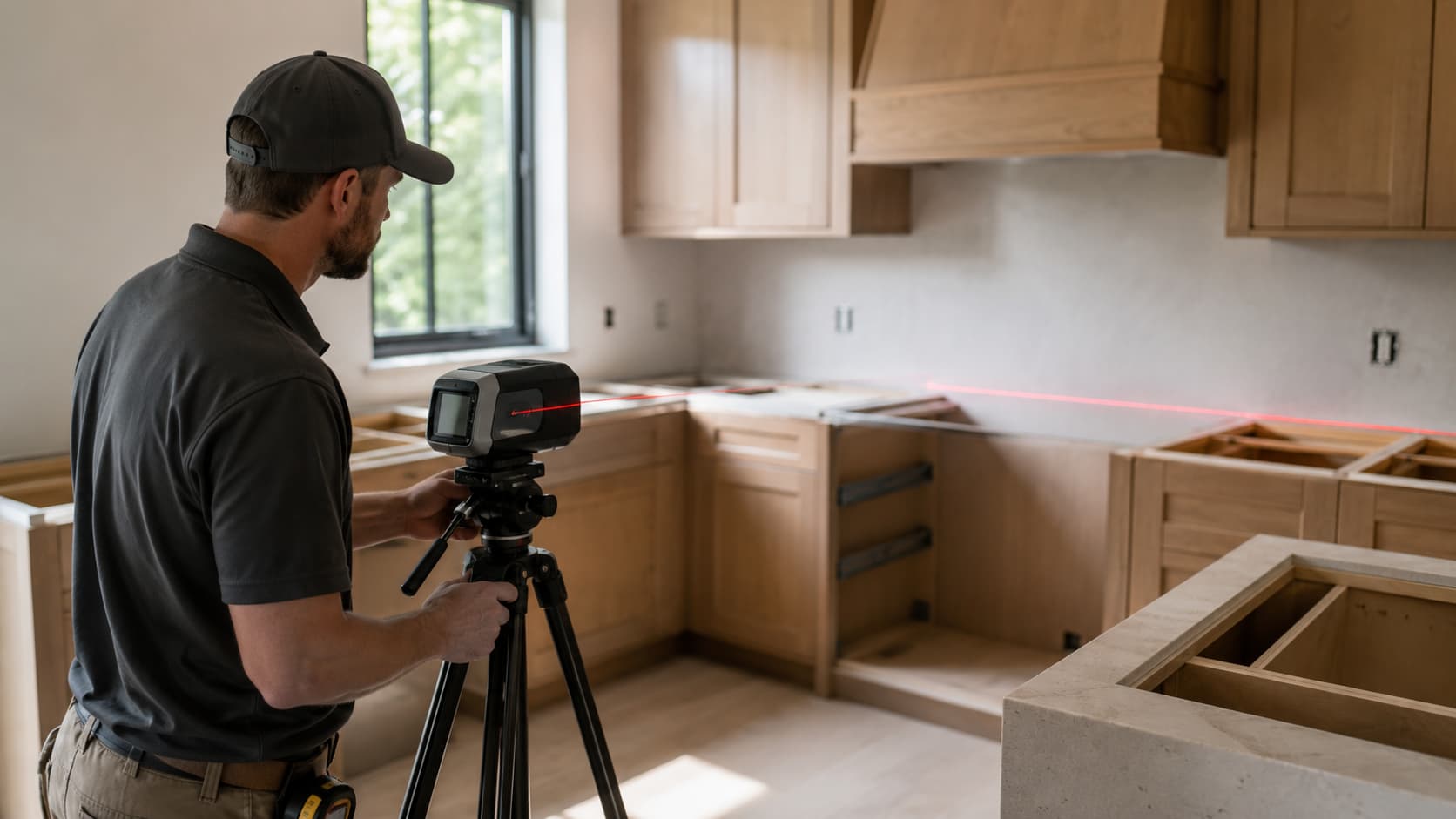
Modern fabrication shops have largely moved away from the old method of building physical templates out of thin wooden strips or cardboard. Today, the standard tool is a digital laser templating system — a tripod-mounted device paired with software that records hundreds of precise points and renders a digital model of your space.
Here is what a typical templating visit looks like from your side of the door:
Walkthrough and confirmation.
The technician reviews the project — which surfaces are being templated, where seams will fall, which edge profile you selected, and how the overhangs should sit. This is your moment to ask about anything you’re unsure of.
Seam placement decisions.
On longer runs and around islands, your countertop will likely require more than one piece of stone. The technician determines where seams should go, balancing structural needs with how visible they’ll be. If seam location matters to you, speak up now — once the slab is cut, it’s cut.
Laser capture.
The device records every wall angle, corner, opening, and dimension. Because it measures the room as it truly is, it accounts for the small imperfections that make hand-measuring so error-prone.
Overhang and detail confirmation.
Standard countertop overhang is about 1.5 inches, but islands with seating, waterfall edges, or custom details all change the math. These details are confirmed on-site.
Final review.
The technician walks you through the captured layout before leaving so you both agree on what will be fabricated.
The appointment itself is usually quick — often under an hour for a standard kitchen — but the accuracy it produces is what makes a smooth installation day possible.
What Happens Between Template and Installation

Once your template is complete, it goes back to the fabrication shop, where the real precision work begins. The digital file guides a CNC saw and waterjet that cut your slab to the exact dimensions captured in your home. Edge profiles are shaped and polished, sink and cooktop openings are cut, and faucet holes are drilled — all in the controlled environment of the shop, not in your kitchen.
This fabrication window typically runs one to two weeks for most projects, though it can vary with material, complexity, and how busy the shop is. Natural stones with dramatic veining sometimes take longer because the slab has to be laid out so the pattern flows correctly across seams — a step called “vein matching” that’s worth the wait on a statement piece.
When fabrication is finished, your installation appointment is scheduled, and the finished pieces are brought to your home ready to be set in place.
How You Can Keep the Timeline on Track
A few simple things on your end can prevent the most common delays:
- Finalize your sink and faucet selections early. These can’t be decided after templating without risking a re-template.
- Have the sink physically on-site for the templating appointment.
- Confirm your cabinets are completely finished and level before the technician arrives.
- Make your seam-placement and overhang preferences known during the template visit, not after.
- Resist last-minute layout changes. Any change to cabinets, sink, or appliance position after templating means the template — and possibly the cut stone — may no longer fit.
The Quiet Step That Makes Everything Else Work
Installation day gets all the attention because it’s the dramatic moment your kitchen comes together. But templating is the step that makes that day go smoothly. A precise template means tight seams, edges that hug your walls, a sink that fits your fixture exactly, and a countertop that looks like it was made for your home — because it was.
If you’re planning a kitchen or bathroom project and want to understand how templating fits into your specific timeline, we’re happy to walk you through it.
Ready to get started? Visit our showroom in Bensenville or call us to schedule your free estimate. We serve Chicago and the surrounding 150-mile area.
One Response
[…] you want a full-height slab backsplash, discuss it before templating. It affects how much material is reserved, how seams are planned, and where outlet cutouts land. […]