

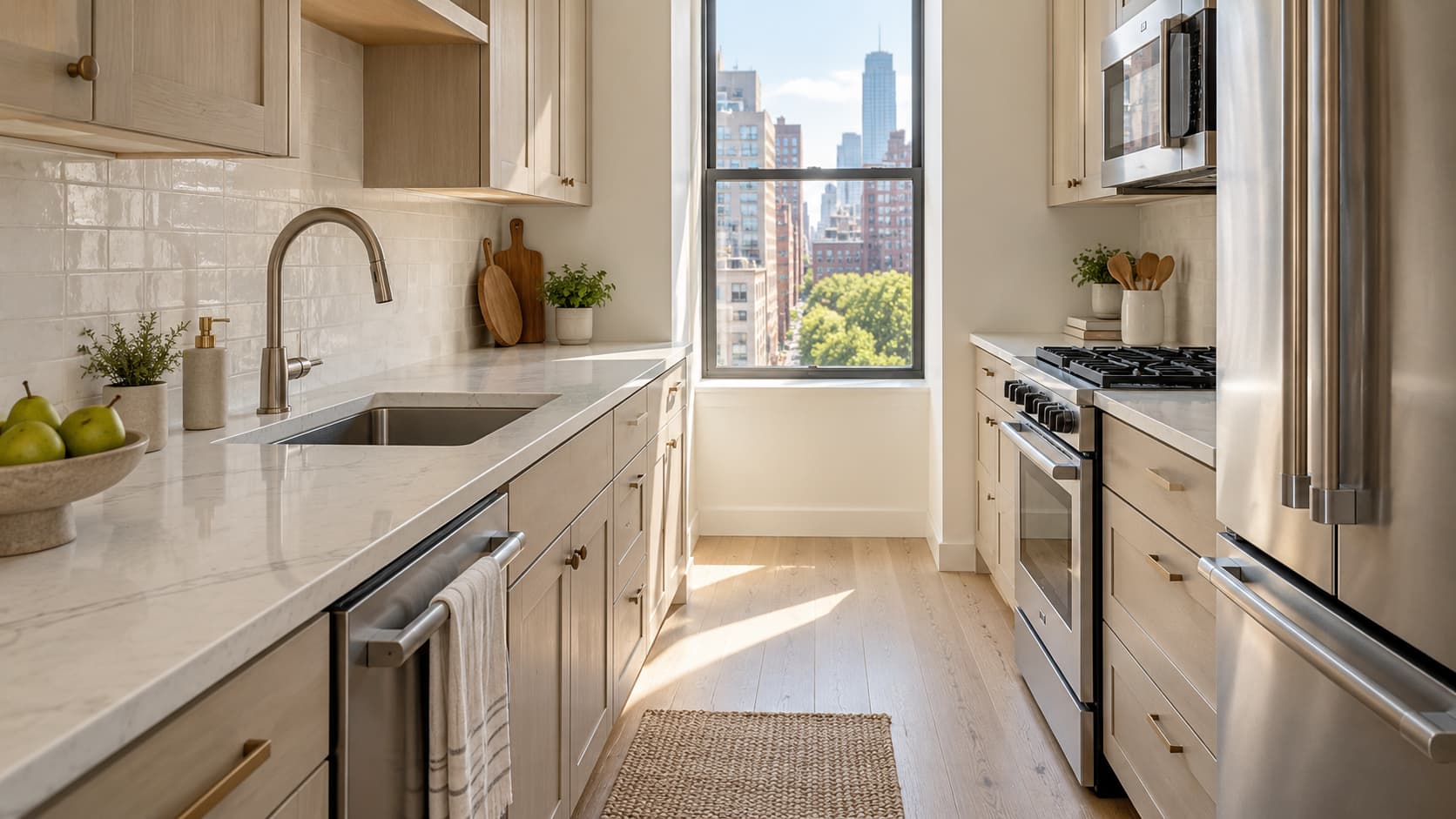
A small kitchen does not have to feel cramped. The right countertop can make the room look brighter, cleaner, and more open while still giving you the durability and work surface you need every day.
This matters especially in Chicago, where galley kitchens, condo kitchens, and compact layouts are common. In a smaller space, countertops make up a large portion of the visible surface area. Their color, pattern, finish, thickness, and relationship with cabinets and backsplash can noticeably change how the entire kitchen feels.
If you are comparing countertops for small kitchens, the goal is not simply to choose the lightest slab available. You also need to think about pattern scale, finish, material, edge profile, and how the countertop will work with the rest of the room.
Here are the most important things to consider.
Start With Countertop Colors That Keep the Kitchen Open
Light-colored countertops are often a natural starting point for a compact kitchen. White, cream, light gray, and soft beige surfaces can help reflect available light instead of visually weighing down the room. This can be especially useful in kitchens with limited natural light or narrow layouts.
That does not mean every small kitchen needs a plain white countertop. Subtle movement, soft veining, or fine speckling can add character without making the surface look busy.
For example, light quartz options such as Bianca Frost and Bianco Supremo can provide a bright, consistent appearance. For homeowners who prefer natural stone, lighter granite choices such as Arctic White or Aspen White can introduce natural variation without making the room feel overly heavy.
If your kitchen already has light cabinetry, you do not necessarily need to match it exactly. A slightly warmer or cooler countertop can create enough contrast to keep the room from looking flat.
For more ideas on coordinating the two surfaces, see our guide to countertops for white cabinets.
Pay Attention to Pattern Size
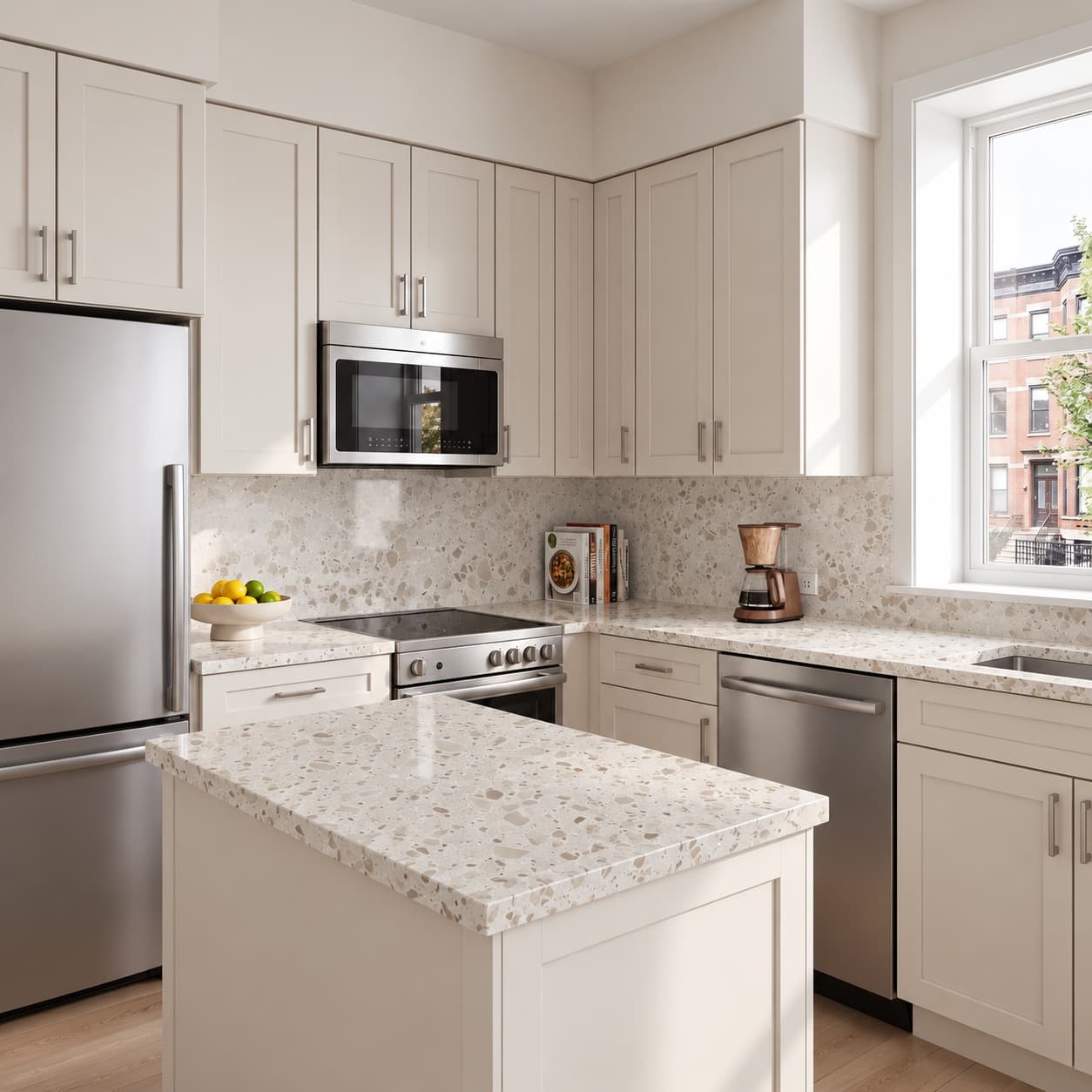
Color is only part of the decision. In a small kitchen, the scale and movement of the pattern can be just as important. A countertop with fine speckling, soft veins, or restrained movement can create a more continuous visual surface, helping the kitchen feel cleaner and less crowded.
Bold patterns create a stronger visual effect. Large Calacatta-style veins or strong dark-and-light contrast can become the dominant feature in the room. That may be exactly what you want for a statement kitchen, but in a very compact space, too much movement can compete with cabinetry, flooring, appliances, and backsplash.
Dark options such as Calacatta Borghini Black quartz or Black Royal quartz, for example, can create dramatic contrast. In a small kitchen, they may work better as an intentional focal point rather than as part of a room already filled with strong patterns.
When planning the overall design, it also helps to consider how the countertop works with the cabinets, backsplash, flooring, and available light. Our guide on how to choose the right countertop for your kitchen design explains how these elements work together.
This is also why choosing a countertop from a small sample can be difficult. A few inches of stone cannot show how a vein runs across an entire slab or how the pattern changes from one area to another. Seeing the full slab makes it easier to judge whether the movement is appropriate for your kitchen.
Choose the Finish With Light and Everyday Use in Mind
The same countertop color can look very different depending on the finish.
Polished
A polished surface has a glossy, reflective appearance. Because it reflects light, it can be especially effective in a small kitchen where the goal is to create a brighter feel.
Polished surfaces also provide the classic smooth appearance many homeowners expect from stone countertops.
Honed
A honed finish is smooth but matte rather than glossy. It can create a softer, more understated look, which works well in contemporary and minimalist kitchens. However, honed surfaces can show fingerprints and grease more readily and may require more frequent sealing.
Leathered
Leathered countertops have a textured surface with a softer sheen. They do not reflect light as strongly as polished surfaces, but the texture can help hide fingerprints, smudges, and water spots.
For a small kitchen where maximizing brightness is the priority, polished surfaces are often worth considering first. If texture or a softer appearance matters more, honed or leathered options can still work well.
Some slabs are also available with dual finishes, such as Aspen White granite in Polished + Leathered finishes, giving you more flexibility when comparing the final look.
A Thinner Countertop Can Create a Lighter Look
Countertop thickness changes more than the structure of the surface. It also changes the visual weight of the kitchen.
Quartz and natural-stone countertops are typically considered in 2 cm and 3 cm thicknesses, while porcelain is also available in slimmer formats such as 1.2 cm.
A 3 cm countertop is approximately 1 1/4 inches thick and is the industry standard for kitchens and islands. A 2 cm countertop is approximately 3/4 inch thick and requires a full plywood base.
For the same material, 3 cm is structurally stronger. From a design standpoint, however, a thinner profile can look lighter and more streamlined. That can be useful in a compact kitchen where bulky visual elements can make the room feel heavier.
Porcelain can be particularly interesting when a slim profile is part of the design. Options such as Apollo White are available in 1.2 cm and 2 cm formats.
The edge profile matters too. A clean eased edge countertop can complement a smaller kitchen because it keeps the countertop lines simple rather than adding unnecessary visual detail.
Which Countertop Material Is Best for a Small Kitchen?
There is no single material that works best in every small kitchen. The better choice depends on the look you want, the level of maintenance you are comfortable with, and how much natural variation you want to see.
Quartz
Quartz is a strong option for homeowners who want a clean and consistent appearance. Light quartz colors can make it easier to create a bright, coordinated kitchen, particularly when working with white, cream, or light gray cabinets.
Quartz does not require sealing, making it a practical choice for homeowners looking for lower maintenance.
Options such as Bianca Frost, Bianco Supremo, Calacatta Apex, Calacatta Lux, and Calacatta Classic can all be considered when looking for a lighter surface.
Quartzite
Quartzite gives you the natural variation of stone while still offering excellent durability.
Light options such as Bianco Superiore, Bianco Supreme, and Bianco Laura can work well when you want natural movement while keeping the overall palette bright.
Because every natural slab varies, viewing the full slab is particularly important.
Granite
Granite remains a practical option for kitchens where natural stone and heat resistance are priorities.
Lighter granites can work especially well in small kitchens because their subtle speckling adds texture without necessarily overwhelming the space.
Options such as Arctic White, Aspen White, Arandis White, Azul White, Bianco Primata, and Alpinus are examples worth comparing.
Marble
Marble can create a softer, more classic appearance.
Options such as Bianco Carrara, Mystery White, Calacatta Vagli, and Calacatta Lincoln feature the light backgrounds and veining many homeowners associate with marble kitchens.
Marble develops patina and requires more care than some other countertop materials, so the appearance should not be the only consideration.
Porcelain
Porcelain can be especially useful when you want a slim, modern countertop profile.
Options such as Apollo White, Boreal Sand, and Calacatta Gold provide lighter designs while allowing for thinner formats.
In a compact contemporary kitchen, that thinner profile can help cabinetry and countertops feel less bulky.
Small Kitchen Countertop Comparison
| Material | Typical Look | Care Notes | Small-Kitchen Consideration |
|---|---|---|---|
| Quartz | Consistent colors and controlled patterns | No sealing required | Good for bright, clean designs |
| Quartzite | Natural movement and variation | Care varies by stone and finish | Adds natural character to a light palette |
| Granite | Natural speckling and variation | Care varies by stone and finish | Fine patterns can add texture without dominating the room |
| Marble | Soft veining and classic appearance | Requires more care and develops patina | Works well when natural character is part of the design |
| Porcelain | Sleek, contemporary appearance | Care depends on the selected finish and product | Thin profiles can create a lighter visual effect |
If you are still comparing the basic differences between these materials, our beginner’s guide to countertop materials is a useful place to start.
Make Every Inch of Countertop Work Harder
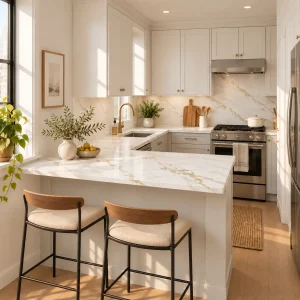
In a small kitchen, design decisions often need to solve more than one problem. A peninsula, for example, may need to function as both prep space and seating.
For quartz countertops, the general unsupported overhang guideline is up to 8 inches for 2 cm material and up to 16 inches for 3 cm material. Longer overhangs require brackets or corbels.
That means a carefully planned countertop can sometimes create a compact breakfast area without requiring a separate table.
Seam placement is another consideration. Seams are often necessary because of slab dimensions and kitchen layout, but smaller kitchens may sometimes be completed with fewer seams or even no seams. The expected seam locations should be discussed before fabrication so the final layout is clear.
The backsplash also has a major influence on how open the kitchen feels. Using too many unrelated colors or competing patterns can divide a small kitchen visually, while coordinating the countertop and backsplash can create a more continuous look.
Don’t Overlook Countertop Remnants
A small kitchen may also be a good candidate for a remnant.
Remnants are pieces of material remaining from larger slabs or projects. Chicago Countertop Co.’s catalog includes both Full Slab and Remnant options.
Because a small kitchen or short countertop run may require less material, a suitable remnant can sometimes cover the project and reduce the amount of material that needs to be purchased.
The remnant still needs to provide enough material for the required pieces, pattern direction, seams, and fabrication. It should be viewed as another material option rather than automatically assuming every small kitchen can be completed from one.
If the countertop is part of a smaller kitchen refresh rather than a full renovation, you may also find useful ideas in our guide on how to update your kitchen without a full remodel.
See the Full Slab Before Making the Final Choice
Small samples are helpful for comparing general colors, but countertops cover a much larger area once installed. That is especially important in a small kitchen because even one slab can have a major influence on the entire room.
Chicago Countertop Co. has over 4,000 full-size slabs at its indoor showroom at 1090 Industrial Drive Unit 5, Bensenville, IL 60106. You can compare granite, quartz, quartzite, marble, and porcelain in person and see how different colors, patterns, and finishes look at full scale.
You can also browse the Live Inventory before visiting.
If you are planning a compact kitchen update and already have measurements or project details, you can use the free online estimate to send the information directly to the sales team.
Frequently Asked Questions About Countertops for Small Kitchens
Do dark countertops make a small kitchen look smaller?
They can create a heavier visual effect, especially when combined with dark cabinets, limited lighting, or strong patterns. However, dark countertops are not automatically a poor choice for a small kitchen. They can work successfully when used as intentional contrast with lighter cabinetry and simpler surrounding finishes.
What is the best countertop color for a small kitchen?
White, cream, light gray, and soft beige are good starting points because they can help create a brighter appearance. However, pattern scale, finish, cabinet color, and lighting also matter. A lightly patterned countertop may work better than a completely plain surface depending on the overall design.
Is a 2 cm countertop thick enough for a small kitchen?
Yes, for most small kitchens, as long as it has the required full plywood base. A 2 cm countertop is approximately 3/4 inch thick, while a 3 cm slab is approximately 1 1/4 inches thick and is structurally stronger. For 2 cm quartz, the general guideline is up to 8 inches of unsupported overhang; longer overhangs require additional support.
Can I use a countertop remnant for a small kitchen?
Potentially. Small kitchens and shorter countertop runs may fit within a remnant, depending on the dimensions and layout of the project. The available piece still needs to accommodate fabrication, seams, and pattern placement.
Should I choose polished or honed countertops for a small kitchen?
If making the kitchen feel brighter is the main goal, a polished surface is worth considering because its glossy finish reflects light. Honed countertops have a softer matte look, while leathered finishes provide texture and help hide smudges and water spots.
Find the Right Countertop for Your Small Kitchen
The best countertop for a small kitchen is not simply the lightest slab or the thinnest material.
A successful choice brings together color, pattern, finish, thickness, and material so the entire kitchen feels balanced.
Start with lighter colors if you want to open up the room, keep pattern scale in proportion to the space, and compare full slabs before making your decision. A subtle quartz may provide the clean consistency you want, while quartzite, granite, marble, or porcelain can bring a different type of character to the same compact layout.
Chicago Countertop Co. serves Chicago and the surrounding 150-mile area. Visit the Bensenville showroom to compare full-size slabs, browse the Live Inventory, or use the free online estimate to get started.
Showroom: 1090 Industrial Drive Unit 5, Bensenville, IL 60106
Phone: 773-632-1600
Hours: Monday-Friday 8:30 AM-5:00 PM, Saturday 8:30 AM-5:00 PM