

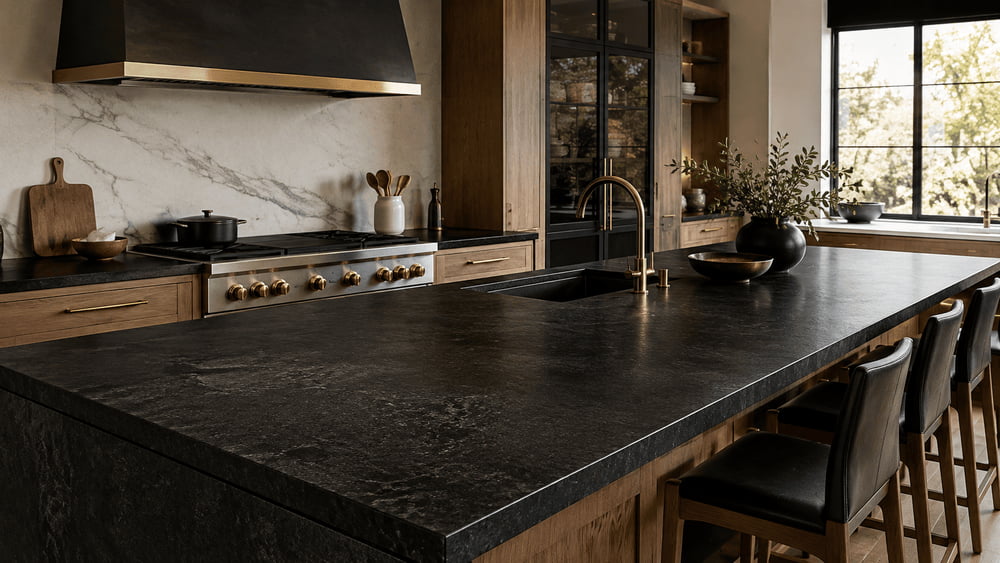
A couple of weeks ago a client came into our Bensenville showroom with a folder of kitchen photos. Every one of them featured a black countertop, and she had one question: “I love this, but everyone tells me it’s a nightmare to keep clean.”
It was a fair concern. Black countertops have a reputation for showing fingerprints, water spots, and dust. Twenty minutes later she was running her hand across a leathered Absolute Black slab, checking it for fingerprints, and finding almost none.
That gap between what people expect from black countertops and how different materials and finishes actually behave is what this guide is about. We’ll compare black granite with black quartz, look briefly at porcelain, explain why finish matters, and walk through some of the black slabs currently in our inventory.
Are Black Countertops Back in Style?
Yes. Black countertops are showing up in more and more of the kitchen photos homeowners bring into our showroom, and two things are driving it.
The first is contrast. After years of all-white kitchens, homeowners want definition without adding another color. A black countertop against white, off-white, or natural wood cabinetry creates a focal point while keeping the palette simple.
The second is finish. Black granite is no longer limited to the mirror-gloss polished look most people picture. Honed and leathered finishes are now common options, and they change how a black surface looks and behaves day to day.
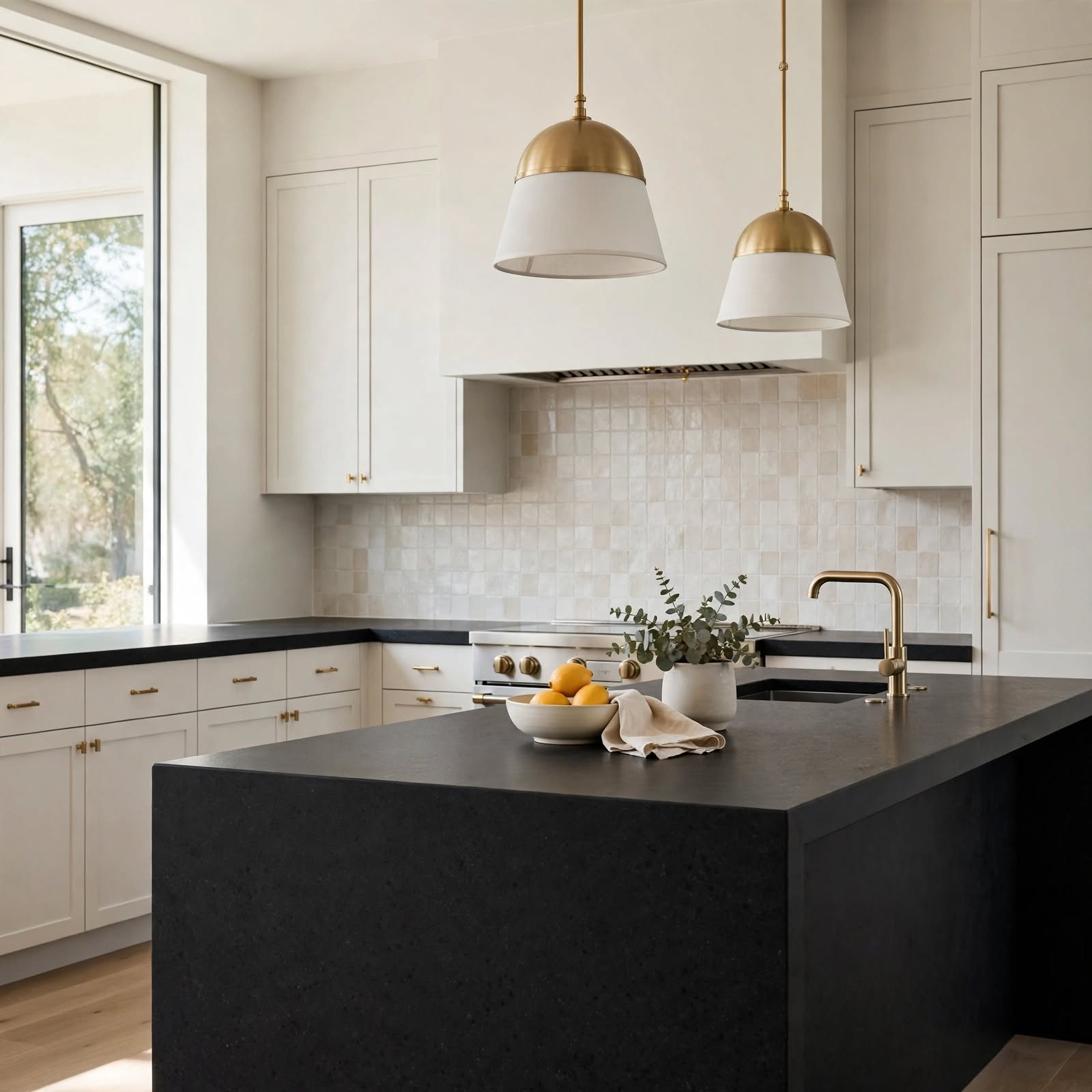
Black Granite vs. Black Quartz vs. Black Porcelain
Each material can produce a black countertop, but they do not behave the same way.
Black granite
Black granite is natural stone, and the darkest varieties are among the densest, lowest-absorption stones used for countertops. Absolute Black in particular has a very tight grain and may absorb little or no sealer.
Granite handles normal kitchen heat well, resists scratching, and carries its color through the material, which helps make small edge chips less noticeable.
The trade-off is variation. Some stones sold as black granite are closer to charcoal, while others have visible crystals, mineral flecks, or movement. That is an advantage if you want natural depth and character, but less ideal if you want a completely uniform black.
Black quartz
Engineered quartz gives you consistent color and a non-porous surface that does not require sealing.
Solid black quartz creates a clean, graphic appearance, while veined black quartz uses white, gray, or gold movement over a black or charcoal background.
Solid polished black quartz is less forgiving when it comes to everyday marks. Fine scratches, dried water spots, and smears catch the light more easily on a uniform dark surface. Veined designs hide them better.
Quartz also needs more care around heat than granite, and prolonged UV exposure can affect some products. Check the manufacturer’s guidance before using quartz outdoors or in heavily sun-exposed areas.
Black porcelain
Large-format porcelain slabs are thin, hard, heat-resistant, and UV-stable. Honed black porcelain is especially effective when you want a clean matte appearance.
The main consideration is the edge. Because many porcelain designs are printed on the surface rather than running through the body, exposed edges may look different from the face. Mitered edges are therefore common. Porcelain can also be more vulnerable to edge chipping from impact than granite.
Quick comparison
| Black granite | Black quartz | Black porcelain | |
|---|---|---|---|
| Fingerprints, polished | Visible | Very visible | Visible |
| Fingerprints, matte / textured | Minimal | Reduced | Minimal |
| Scratch resistance | Excellent | Good | Excellent |
| Heat resistance | Excellent | Moderate | Excellent |
| Sealing | Depends on stone | Never | Never |
| Color consistency | Varies by slab | Very consistent | Very consistent |
| Outdoor use | Generally suitable | Usually not recommended | Suitable |
| Edge chip visibility | Low | Low | Can be noticeable |
For Black Countertops, Finish Matters as Much as Material
When it comes to fingerprints, water spots, and everyday appearance, finish matters at least as much as the material itself.
Polished black
Polished black gives you the deepest color and strongest reflection. It can help bounce light around a darker kitchen, but it also shows fingerprints, dried water spots, dust, and cleaning streaks more easily.
If you routinely wipe and dry your counters, polished black can look striking. If you want a surface that stays visually tidy with less attention, a matte or textured finish may be easier to live with.
Honed black
Honing removes the gloss and creates a smooth matte surface. It hides fingerprints better than polish and gives black stone a softer, more understated appearance.
Keep in mind that honing can also change the apparent color. A granite that looks jet black when polished may appear closer to dark charcoal when honed.
Leathered black
Leathering adds a subtle texture that follows the natural grain of the stone. In our experience, it is one of the easiest black countertop finishes to live with because the texture scatters light and makes fingerprints, crumbs, water spots, and minor marks less noticeable.
Several of our black granites are available leathered or as dual-finish slabs so you can compare finishes before fabrication.
Black Granite Countertops: Options in Our Current Selection
Inventory changes, so treat this as a snapshot and check our live inventory for current availability.
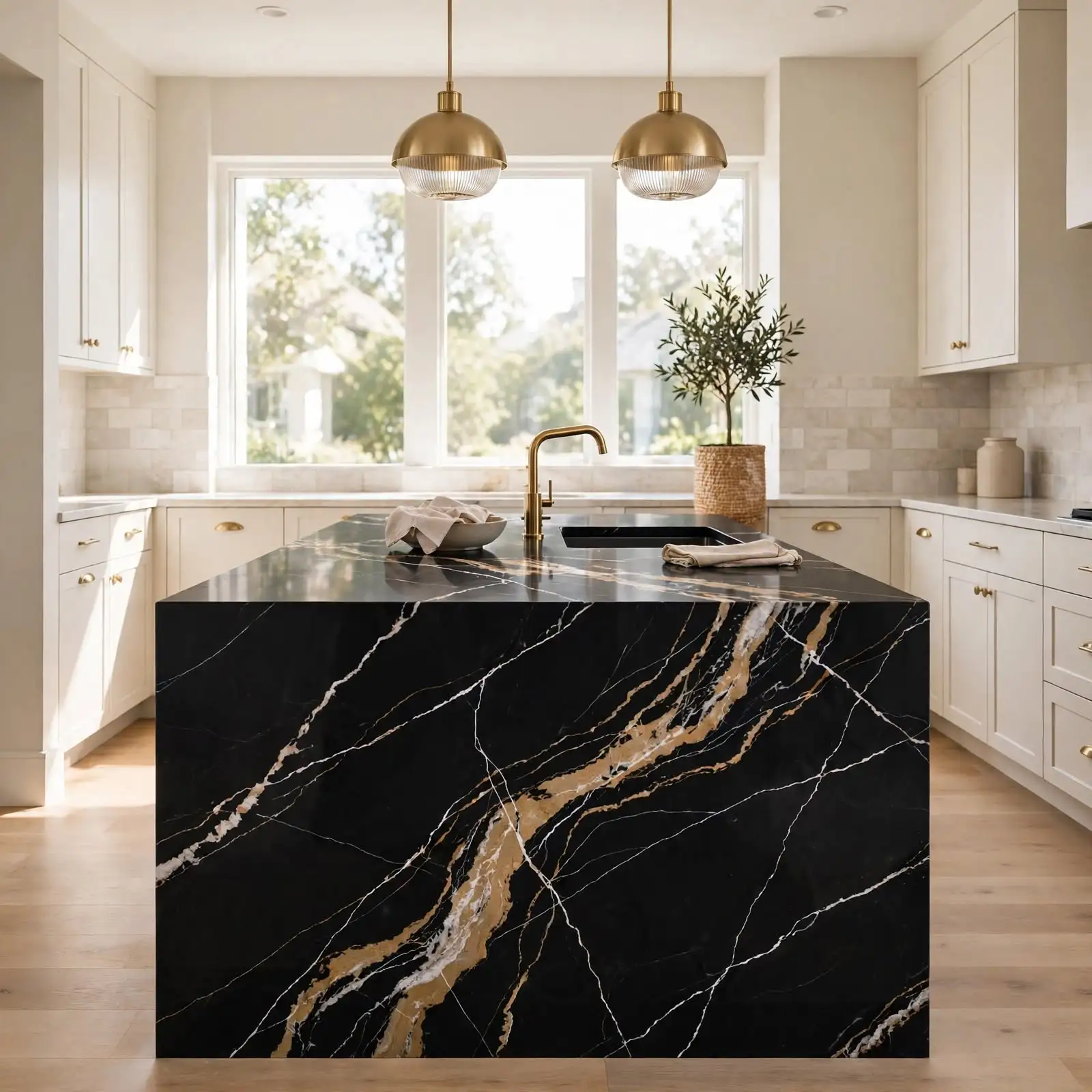
Absolute Black
Absolute Black is the benchmark for a dense, uniform black granite with very little visible pattern.
Our current slabs are dual polished/honed, allowing you to compare both finishes on the same stone. It also sits in our Basic tier, making it one of the more economical ways to get a solid-black natural-stone countertop.
One thing worth asking any supplier is whether the stone has been dyed to deepen its color. Some Absolute Black on the market is treated this way. Our slabs are not dyed.
Steel Gray
Steel Gray is not a true black but often appeals to homeowners who come in looking for one.
Its deep charcoal color and fine crystal pattern feel softer than Absolute Black, especially in a leathered finish. It works particularly well with gray, greige, white, and natural wood cabinetry.
Cosmic Black
Cosmic Black has sweeping lighter mineral movement across a dark background.
It offers more drama than a uniform black, so viewing the full slab before fabrication is especially important, particularly for large islands.
Black Amber
Black Amber is a leathered dark granite with warm amber and bronze mineral flecks.
We often recommend it with walnut or oak cabinetry and brass hardware, where a completely uniform black can feel too cool.
Other patterned black granites
Cygnus Black, Python Black, Vincent Black, and Vitoria Black are better suited to homeowners who want visible movement and texture rather than a flat black surface.
Because all four vary noticeably from bundle to bundle, they are worth seeing in person.
Laguna Black is another option for homeowners who want a polished dark granite with subtle natural depth.
Black Quartz Options in Our Current Selection
Absolute Black Quartz
Absolute Black Quartz provides a solid, consistent black surface.
It makes sense when uniformity across a large kitchen is the priority, but polished solid-black quartz will show everyday marks more readily than lighter or patterned designs.
Black Royal
Black Royal comes in a jumbo 139″ × 80″ format.
The larger slab can reduce seams on long countertop runs and oversized islands, which is especially useful because seams may be more noticeable on dark surfaces.
Veined black quartz
Calacatta Borghini Black, Calacatta Black Sea, and Statuario Black/Gold combine dark backgrounds with white, gray, or gold veining.
They provide some of the visual character associated with dark marbles such as Nero Marquina or Portoro while being more forgiving in everyday use than solid polished black quartz.
A Black Porcelain Option
For a thin matte-black surface, Onice Black is a honed 1.2 cm porcelain slab.
It works particularly well for fireplace surrounds, bathroom vanities, and modern kitchens where a slim edge and strong heat resistance are priorities. For full kitchens, edge fabrication and substrate should be planned carefully.
What Goes With Black Countertops?
Black countertops are versatile, but the surrounding materials determine whether the room feels balanced or overly dark. We covered the reverse question in our guide to countertops for dark cabinets.
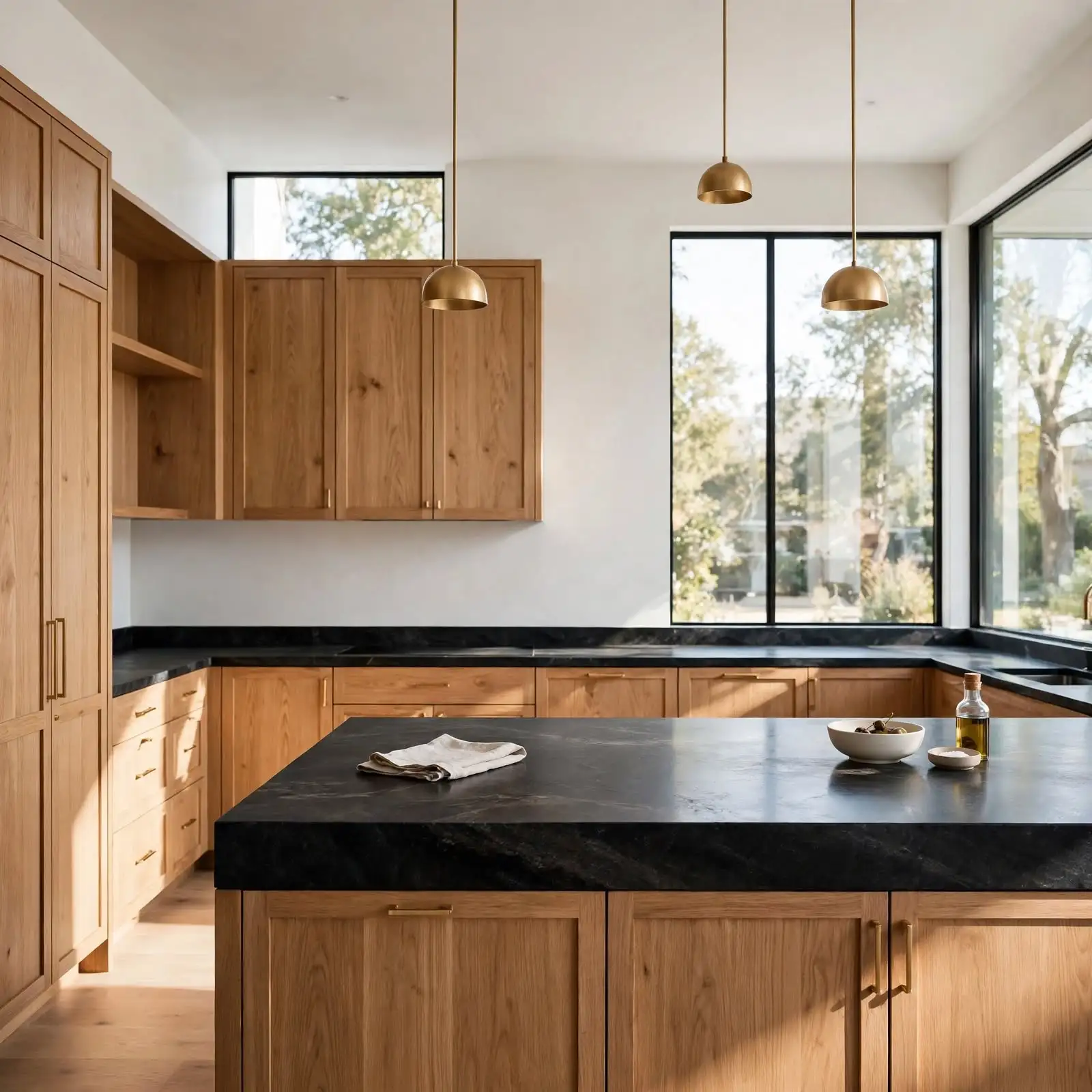
- White or off-white cabinets: The classic high-contrast combination. See our countertops for white cabinets guide for more pairings.
- Natural wood: White oak, walnut, and rift-cut oak soften black and add warmth.
- Sage, olive, and muted green: Black gives soft green cabinetry more definition.
- Gray and greige: Steel Gray can work especially well when you want a tonal rather than high-contrast palette.
- Black on black: Possible, but lighting and lighter surrounding materials become much more important.
- Backsplash: White subway tile, zellige, or a simple full-height slab can all work. If the countertop has strong movement, keep the backsplash quieter.
- Hardware: Brass and bronze warm up black stone, while matte black hardware creates a more monochrome look.
A note on Chicago light
Many Chicago condos, bungalows, and older homes have kitchens with limited natural light, especially in winter.
A polished black surface reflects more available light, while a large expanse of matte or leathered black can feel visually heavier. That does not rule out darker finishes, but cabinetry, flooring, backsplash, and artificial lighting should be considered together.
If possible, bring a daylight photo of your kitchen when visiting the showroom. It can change which black surface makes the most sense.
How to Care for Black Countertops
Black countertops do not necessarily get dirtier than lighter ones. They simply make dust, dried water, fingerprints, and streaks easier to see.
A few habits help:
- Clean with a microfiber cloth and water or a pH-neutral cleaner.
- Dry polished black after wiping to reduce hard-water spots.
- Test dense black granite before sealing it rather than automatically applying sealer. Pour a little water on the surface and wait fifteen minutes. If the stone does not darken, it is not absorbing and does not need sealer.
- Never seal quartz.
- Use trivets under hot cookware on quartz.
- Use cutting boards on every countertop material.
- Repair small chips in natural stone with properly color-matched materials.
For more detail, see our guide to 7 everyday habits that quietly ruin your countertops.
For expected lifespans by material, see how long countertops last.
How Much Do Black Countertops Cost in Chicago?
Black does not carry a premium simply because of its color. Material, slab tier, finish, fabrication, and installation conditions determine the final cost.
Black granite: Absolute Black sits in our Basic tier, while patterned or specialty-finished stones such as Black Amber, Cosmic Black, Cygnus Black, and Python Black move into higher tiers. See our granite countertop cost guide for current Chicago-area pricing.
Black quartz: Solid black quartz generally sits in the mid-range, while veined and jumbo-format options can move into higher pricing tiers. See our quartz countertop cost guide for more detail.
Finish and installation: Honed or leathered finishes may affect price depending on how the slab arrives, while Chicago high-rise installations can add logistical costs for freight elevators, loading docks, and insurance requirements.
How to Choose the Right Black Slab
- View the full slab. Small samples cannot show the full movement or variation of natural stone.
- Compare finishes under your own lighting. Look at polished and matte samples during the day and at night.
- Confirm the bundle. If you need more than one natural-stone slab, choose them from the same bundle when possible.
- Plan seams before fabrication. Seams may be easier to notice on dark surfaces.
- Keep the edge practical. Simple edges are easier to maintain and repair.
- Know what you are buying. “Black granite” is a commercial category, and some stones sold under that name are geologically gabbro or dolerite.
Black Countertops FAQ
Are black countertops hard to keep clean? Not necessarily. Polished solid black surfaces show fingerprints and water spots more easily, while honed, leathered, and patterned black surfaces are more forgiving.
Does black granite need to be sealed? It depends on the stone. Dense varieties such as Absolute Black may absorb very little. Test the specific slab before applying sealer.
Is black granite or black quartz better? Granite has an advantage in heat and scratch resistance, while quartz offers consistent color, a non-porous surface, and no sealing. The better choice depends on how you use the kitchen and the appearance you want.
Do black countertops scratch easily? Black granite does not. Quartz resists scratching well too, but fine marks are more visible on a dark, uniform surface. Use cutting boards regardless.
What is the most popular black granite? Absolute Black remains the most requested in our showroom. Steel Gray in a leathered finish is a close second for homeowners who want a softer charcoal, and Cosmic Black is the choice for those who want movement.
Do black countertops make a kitchen look smaller? They can make a room feel heavier if every major surface is dark. With lighter cabinetry, flooring, backsplash, or sufficient lighting, black countertops usually create contrast rather than making the kitchen feel smaller.
Can black countertops be used outdoors? Black granite and porcelain are generally suitable when properly installed. Quartz is usually not recommended for prolonged outdoor UV exposure unless the manufacturer specifically approves it.
Do black countertops work with white cabinets? Yes. It is one of the most established high-contrast combinations. Polished black feels sharper and more formal, while honed or leathered black creates a softer look.
See the Black Slabs in Person at Our Bensenville Showroom
Black stone is difficult to judge from photos. A screen can make charcoal look black, flatten natural movement, and hide the difference between polished, honed, and leathered finishes.
Start by browsing the black granite and quartz in our live inventory and shortlist a few slabs. Then come see them at full size.
Call (773) 632-1600 or make an appointment. Bring your kitchen layout, a cabinet door or sample if you have one, and a photo of the room in natural light.