

Installation day is the moment your kitchen or bathroom finally comes together. The slab you chose, the edge profile you deliberated over, the veining you fell in love with — it all becomes real. A little preparation the day before and a clear sense of what to expect will make the whole experience smooth, fast, and genuinely exciting.
— Part One
Before Installation Day
The work you do the evening before — or even a few hours before the crew arrives — can shave hours off the installation and prevent unnecessary stress. Professional installers carry slabs weighing anywhere from 200 to 400 lbs. A clear, obstacle-free path from your front door to the kitchen is not just convenient; it’s a safety requirement.
Pre-Installation Checklist
Clear your countertops completely. Remove small appliances, decorative items, dish racks, canisters, and anything else sitting on the existing surface. Fragile items should be stored away from the work area entirely.
Create an unobstructed path. Move rugs, cords, furniture, bikes, and toys from the entry route to the kitchen or bathroom. If you have hardwood floors you’re worried about, ask the team in advance — most professional crews lay down drop cloths or cardboard to protect them.
Secure pets and arrange childcare. Heavy slabs moving through tight doorways require full concentration. Pets and children should be kept safely out of the work zone for the entire duration of the installation.
Confirm your sink and appliances are on-site. If you’re getting a new under-mount sink, it must be available before installation. The fabricator cuts the sink opening to fit your exact fixture. Missing hardware causes delays.
Plan for temporary kitchen downtime. Most residential countertop installs take 2–6 hours. Your sink will be disconnected during that time. Have water bottles and simple meals planned; consider having breakfast before the crew arrives.
Confirm all details with your installer the day before. A quick call to verify arrival time, access instructions, and any last questions ensures everyone is aligned and nothing is left to chance.
A note on older Chicago homes
Chicago’s housing stock includes everything from high-rise condos to century-old bungalows. In vintage homes, walls are rarely perfectly square and cabinets may sit slightly out of level. Your installation team will bring shims and make on-site adjustments — this is routine, not a problem. Just budget for a potentially longer install window than a newer construction.
— Part Two
What Happens During Installation
Understanding the sequence of events helps you know when it’s fine to step out for coffee and when you should be present. Here is how a typical installation unfolds, step by step.
Old countertop removal
The first task is removing your existing surface. The process generates some noise and, if you have a tile backsplash, there may be minor breakage along the bottom row. This is normal — plan to address the backsplash as part of the project if it’s important to you.
Cabinet preparation and leveling
Before any stone goes down, the installation team inspects your cabinet bases and levels them with shims where needed. A perfectly level substrate is what prevents the new countertop from cracking over time. In older Chicago homes this step can take meaningful time — it’s worth every minute.
Dry-fit and alignment check
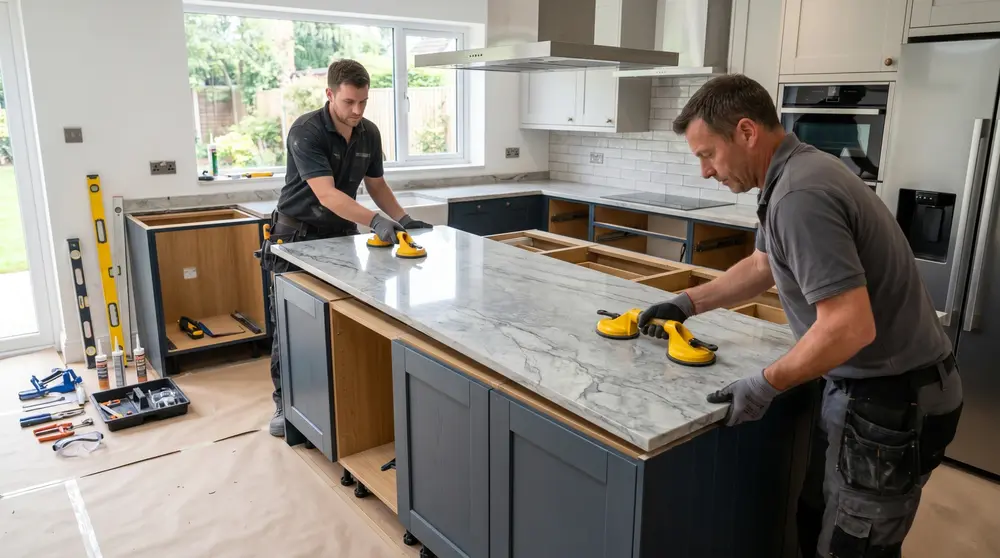
Each slab section is carried in using suction lifters and harnesses and placed on the cabinets without adhesive first. The crew confirms alignment, checks that seams are tight, and makes any small trims needed for walls that aren’t perfectly straight. Only once everything fits correctly does the gluing begin.
Seaming where applicable
Where two slabs meet — at corners, across long runs, or around islands — the team applies a color-matched epoxy resin tinted to follow your stone’s natural veining pattern. Seam setters clamp the pieces together while the resin cures. Done well, seams are smooth and nearly invisible.
Sink cutout and fixture placement
If your countertop includes an undermount sink, the cutout has already been precision-cut at the fabrication shop to match your exact fixture. On-site, the crew confirms the fit, applies silicone, and secures the sink from below. Faucet holes are verified or drilled to specification.
Final polish, cleanup, and walkthrough
After the stone is set, the team polishes the surfaces, removes any adhesive or dust, and cleans the area. You will be asked to walk through the finished installation — inspect seams, check alignment, run your hand along the edge profiles, and confirm the sink fit. Ask any questions at this stage before signing off.
“Knowing the sequence means you can relax. When the crew is leveling cabinets or waiting for seam epoxy to cure, that’s not a delay — that’s the work.”
— Chicago Countertop Co.
— Part Three
After Installation: Protecting Your Investment
The installation is complete. The countertops look stunning. What you do in the first 24 to 48 hours — and in your ongoing care routine — determines how well they hold up for the next decade and beyond.
The first 24 hours
Allow the silicone around your sink and any adhesive under the stone at least 24 hours to fully cure before placing heavy objects on the countertop or running water through the sink. Avoid cutting directly on the surface during this window, and keep the area dry.
If your installer applied a sealant during installation standard for granite and marble, sometimes quartzite, that protective layer is still curing. Follow any specific guidance your fabricator provides — they know your material best.
Material-specific care
Granite
Extremely durable and heat-resistant. Seal once a year using a penetrating stone sealer. Wipe spills promptly — granite is resistant to stains but not impervious to them if liquids sit for extended periods.
Quartz
Non-porous and requires no sealing. Avoid placing hot pots directly on the surface — quartz contains resins that can discolor under sustained high heat. Use trivets. Clean with mild soap and water.
Quartzite
Harder than marble, but like granite it is a natural stone and benefits from annual sealing. Avoid harsh chemical cleaners; pH-neutral stone cleaner is ideal. The dramatic veining is worth protecting.
Marble
Timeless and elegant, but requires attentive care. Acidic liquids — citrus, wine, vinegar — can etch the surface. Seal regularly, use cutting boards and trivets religiously, and clean spills the moment they occur.
Everyday habits that extend countertop life
Long-term care guidelines
Use cutting boards for all food prep. No stone countertop — however hard — benefits from knife contact, and you will dull your knives on the stone in any case.
Always use trivets or heat-resistant pads under hot cookware, even on granite. The thermal shock of a very hot pan meeting a cold stone surface can cause cracking over time.
Clean with mild, pH-neutral soap and warm water. Avoid abrasive scrubbers, bleach, and ammonia-based cleaners on natural stone — they degrade the sealant and can etch the surface.
Re-seal natural stone granite, quartzite, marble annually. A simple at-home water test tells you when it’s time: if water no longer beads on the surface, a new coat of sealant is due.
Address chips or cracks promptly. Small chips in natural stone can be repaired with color-matched epoxy. Delaying repairs allows moisture infiltration and can turn a minor issue into a major one.
Ready to get started?
Visit our showroom in Bensenville or call us to schedule your free estimate. We serve Chicago and the surrounding 150-mile area.