

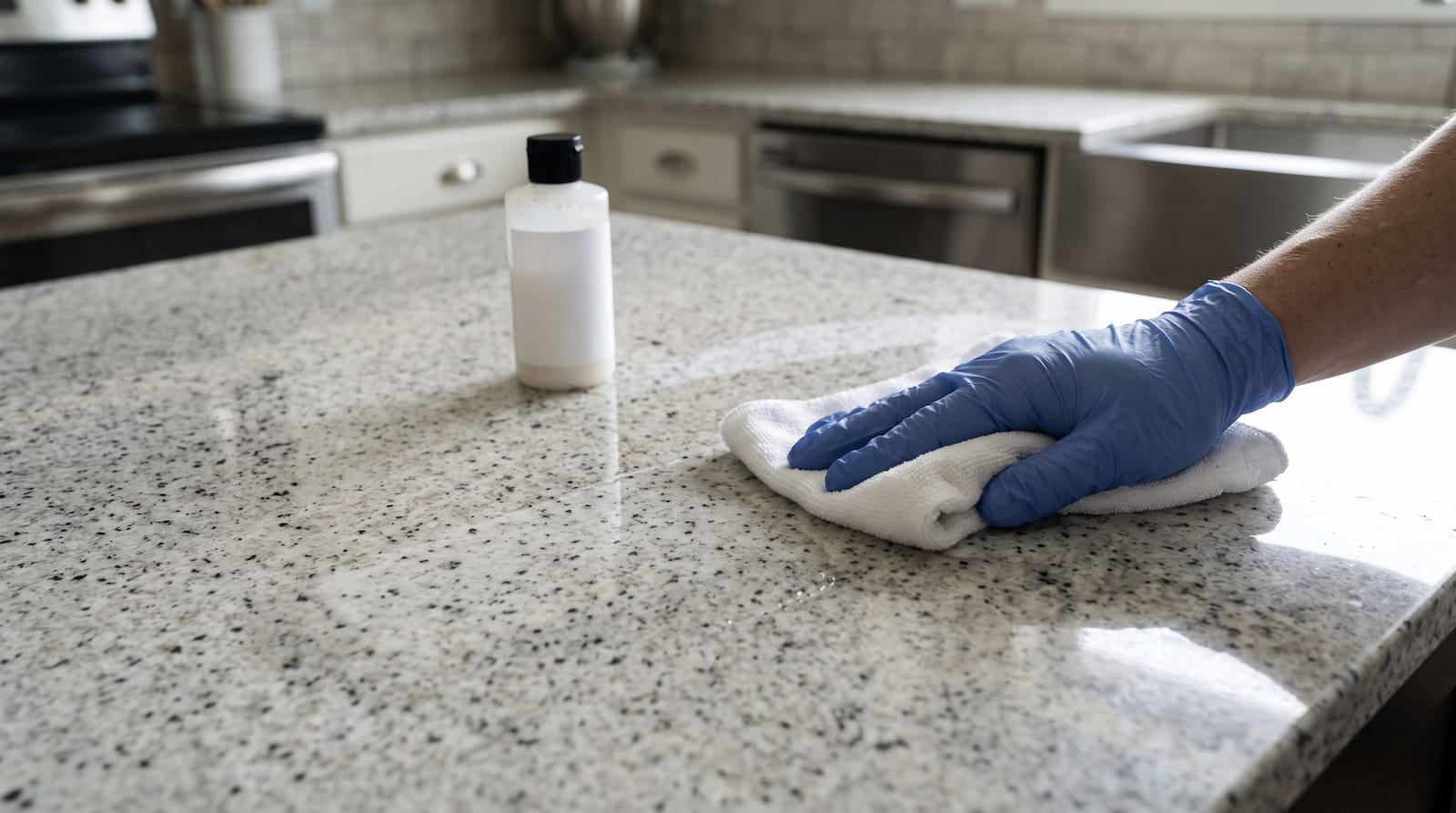
Applying sealer to a natural stone countertop is a short job, but it’s only one part of the process. Plan for extra time to clean the stone, let it dry and let the sealer cure, following the product’s instructions. Some stones barely need sealing at all, and a few popular countertop materials should never be sealed. At Chicago Countertop Co., we fabricate and install granite, marble, quartzite, quartz and porcelain countertops across the Chicago area, and this guide shares how our team recommends caring for each one.
Why Some Natural Stone Countertops Benefit from Sealing
Granite, marble and quartzite have tiny pores between their mineral grains. On a more absorbent slab, wine, oil or coffee can soak in below the surface, where a sponge can’t reach it. That’s how dark rings and oily shadows appear.
Countertop sealers are “impregnating” (or penetrating) sealers. Instead of coating the surface like varnish, they soak into the pores and line them, so spills stay on the surface long enough for you to wipe them away. Not every stone needs this: the Natural Stone Institute notes that most granite countertops don’t require sealing, although many still benefit from it.
Two things a sealer won’t do:
- Make stone stain-proof. It buys you time, but a glass of wine left overnight can still leave a mark.
- Stop etching on marble. Etching is a chemical reaction between acids and the calcium in marble. Sealer doesn’t prevent it.
Which Countertops Need Sealing (and Which Don’t)
Sealing a non-porous surface does more harm than good: the sealer has nowhere to go, dries on top, and leaves a cloudy haze.
| Material | Sealing | How often to check |
|---|---|---|
| Granite | Depends on the slab; many need little or none | Water test once a year |
| Marble | Often recommended | Water test every 6 months |
| Quartzite | Depends on the slab | Water test once a year |
| Quartz (engineered) | Never | Not needed |
| Porcelain | Not needed | Not needed |
Resealing intervals vary by slab, surface finish, use and sealer. Check water absorption periodically and follow your fabricator’s and sealer manufacturer’s recommendations.
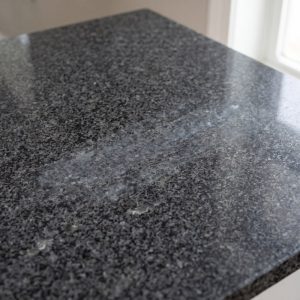
Granite’s absorbency varies from slab to slab. Some lighter granites absorb more, while dense dark granites such as absolute black may absorb so little that sealer can’t get in at all.
Marble is sensitive to acids, while its absorbency varies by slab. Sealing can help reduce staining, but it does not prevent etching from lemon juice, vinegar or tomato sauce. If you love marble, plan on a little patina or choose a honed finish, where etches show less.
Quartzite is usually hard and dense, but some stones sold under quartzite names behave more like marble or dolomite. Test your own countertop rather than trusting the name.
Quartz and porcelain have no pores for liquid to enter. Don’t seal them; warm water and a pH-neutral cleaner are all they need.
Choosing a new countertop? If low maintenance matters to you, the material you choose matters more than any sealer. At Chicago Countertop Co., you can compare more than 4,000 full-size slabs of granite, quartzite, marble, quartz and porcelain side by side in our indoor showroom, and our team will tell you honestly how much care each one needs. See what’s in stock now in our Live Inventory.
The Water Test: Does Your Countertop Need Sealing?
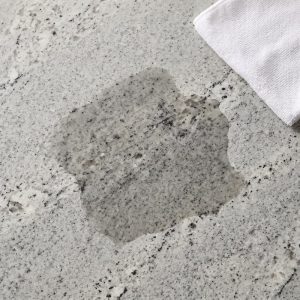
- Pour a small puddle of water, about 3 inches across, in a spot that gets heavy use, such as near the sink.
- Check it after a few minutes, then at 10, 20 and 30 minutes.
- Read the result:
- No darkening after 30 minutes: the stone may already be adequately sealed, or it may naturally have low absorbency. Either way, it likely doesn’t need sealing now.
- Darkens within 10–30 minutes: the stone is absorbing some water. Sealing may help.
- Darkens within a few minutes: the stone is absorbent and is a good candidate for sealing.
Wipe the water away when you’re done. Any darkening should fade as the stone dries; how long that takes depends on the stone, temperature and humidity.
How to Seal Granite, Marble and Quartzite Step by Step
You’ll need a penetrating sealer made for natural stone countertops, a pH-neutral stone cleaner, several lint-free microfiber cloths, and good ventilation. Read the sealer’s label first: application, drying and cure times vary by product, and the label always wins over a general guide.
- Clean the countertop. Clear everything off and clean with a pH-neutral stone cleaner. Remove any existing stain first, because sealing over it locks it in.
- Let the stone dry completely. Sealer can’t enter pores full of water. Wait several hours at least; many manufacturers recommend 24 hours, especially for marble and light stone.
- Test a hidden spot. Make sure the sealer doesn’t darken the stone or leave a haze. This matters most on honed and leathered finishes.
- Apply in sections. Work about 2–3 feet at a time, with an even coat that leaves the surface looking wet.
- Let it soak in for the dwell time on the label, often 5–15 minutes.
- Wipe off all the excess. Before it dries, buff the section with a clean, dry cloth. Sealer left on the surface can dry into streaks or a cloudy film.
- Add a second coat if needed. Absorbent granites, marble and honed finishes often need one.
- Let it cure for the time specified on the label before exposing the surface to water or testing it again.
How Often to Reseal
There’s no single schedule. It depends on the stone, its finish, the sealer and how hard you use your kitchen. A quality sealer can last for many years, so let the water test decide rather than the calendar:
- Busy kitchen, light granite or marble: run the water test every 6 months
- Most granite and quartzite: run it once a year
- Bathroom vanity or low-use surface: run it once a year or less
Reseal when the test shows the stone darkening within 30 minutes.
Harsh cleaners wear sealer down fastest. Vinegar, bleach and many all-purpose sprays break it down and can etch marble; we cover this and other mistakes in 7 Everyday Habits That Quietly Ruin Your Countertops. Finish matters too: honed and leathered surfaces tend to absorb more than polished stone, as explained in Honed vs. Polished vs. Leathered Countertops.
Not sure what stone you have? If your countertops came from Chicago Countertop Co., get in touch and our team can tell you which stone was installed and what care it needs.
Common Mistakes to Avoid
- Sealing quartz or porcelain. The sealer dries on top as a film.
- Over-applying to dense stone. If water never darkens your granite, more sealer only adds residue.
- Sealing in a cold, closed-up room. Many sealers list a temperature range, and solvent-based ones give off fumes. In a Chicago winter, keep the house at normal room temperature and run the hood fan.
Already have haze? Check the sealer manufacturer’s instructions; some recommend reapplying a little sealer and buffing it off, others a specific remover. Already have a stain? Many oil stains can be lifted with a poultice. Deep stains, chips and etching are best left to a stone professional.
Planning a New Countertop?
If you’d rather spend less time on upkeep, or your countertop has seen better days, the right material makes the biggest difference. Visit Chicago Countertop Co.’s indoor showroom to see more than 4,000 full-size slabs in person, from easy-care quartz and porcelain to natural granite, quartzite and marble. Our own team handles everything from measuring and fabrication to installation, across Chicago and the area within about 150 miles. Contact us to schedule a visit or get a quote.