

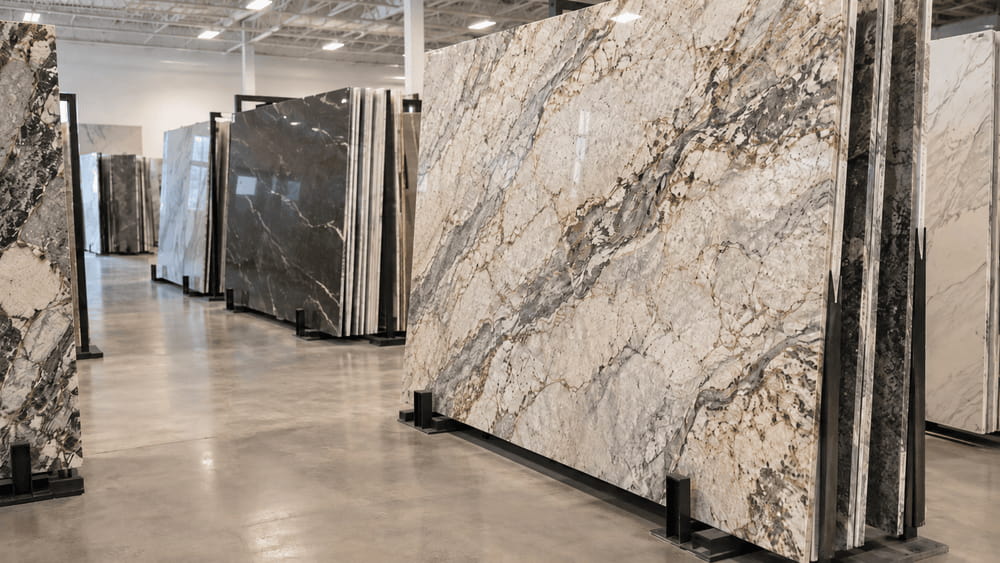
Photos and small samples are a good starting point, but a screen never fully captures natural stone. Every slab has its own movement, color shifts and quirks, and the only way to know what you’re getting is to stand in front of it. Here’s what to check at the slab yard.
Why Seeing the Full Slab Matters
A 4-inch sample shows color and finish, but it can’t show how veining flows across 9 or 10 feet of stone. Two slabs of the same granite or quartzite can look quite different depending on where they were cut from the quarry block. Some have calm, even patterns. Others have dramatic swirls, heavy veins or large mineral deposits. None of these is wrong, but you should choose before fabrication starts, not after installation.
That’s why Chicago Countertop encourages homeowners to see their actual slab before signing off. If you’re still comparing materials, start with our guide on what Chicago homeowners should know before buying new countertops.
Come Prepared
A slab yard visit goes faster when you bring:
- A cabinet door or paint sample. Colors shift under different light, so compare the stone directly against your cabinets.
- Flooring and backsplash samples, if you’ve already chosen them.
- Kitchen measurements or a rough layout. These show how many slabs you need and where seams may fall.
- Your phone. Take photos and short videos of every slab you like, including close-ups and the slab’s tag number.
What to Look for on the Slab
1. Overall Pattern and Movement
Step back a few feet and look at the whole slab. Are there areas you’d want to avoid, like a large dark patch or a cluster of heavy veining? Picture where the sink, cooktop and island will go. A good fabricator can often arrange the layout to show off the best sections and leave out the ones you don’t like.
2. Color Consistency
Check whether the color changes from one end of the slab to the other. If your project needs more than one slab, ask to see them side by side. Slabs cut from the same block, often numbered in sequence, match most closely. This is especially important on large islands and long countertop runs where adjacent pieces will be seen together.
3. Surface Finish
Run your hand across the surface. A polished finish should feel smooth and have a consistent shine. Some variation in reflection can come from the stone’s minerals, but dull spots may be worth asking about. Make sure the finish you’re looking at is the one you’ll order, because finish changes how color and veining look.
4. Pits, Fissures and Cracks
Natural stone often has small pits and fissures. Fissures are natural lines in the stone and usually aren’t a structural problem. Cracks are breaks, and you can often feel them with a fingernail. Look at the slab from an angle so the light rakes across it, which makes surface flaws easier to see. If you’re unsure about a mark, ask the staff whether it’s natural character or a defect.
5. Resin and Repairs
Many granite and quartzite slabs get a resin treatment at the factory to fill small voids and strengthen the surface. Still, watch for cloudy patches, heavily filled areas or visible repair lines, and ask how the slab was treated. Our granite countertops buyer’s guide covers this in more detail.
6. Edges and Back
Check the edges for chips. If the slab has a mesh backing, don’t worry: it’s common and adds support during handling.
Tips by Material
- Granite: Look closely at large mineral crystals and pattern variation. Busy granites hide seams well, while uniform ones show them more.
- Quartzite: Ask your fabricator or supplier to confirm that the slab is true quartzite, since some softer stones may be marketed under similar names. Also pay attention to veining, natural fissures and color variation across the full slab.
- Marble: Expect variation in the veining and a softer surface. Ask about honed and polished finishes, since a honed finish hides etching better.
- Quartz: Engineered quartz is much more consistent, so the in-person check is mostly about color and pattern scale under real light. If the design has veining, still look at a full slab.
- Porcelain: The pattern is often printed on the surface, so ask how it will look on edges and mitered corners.
Check the Lighting
Showroom and warehouse lights are often brighter or cooler than kitchen lighting. If you can, look at the slab near a window or under different light. Whites can look gray, and warm beiges can look pink or yellow depending on the bulb.
Questions to Ask Before You Buy
- Is this the exact slab I’ll receive, or one from the same lot?
- How many slabs do I need, and where will the seams go?
- Can the slab be put on hold or tagged with my name?
- What finish is this, and are other finishes available?
- Does the stone need sealing, and how often?
- What are the lead times for templating and installation?
The Chicago Countertop team can answer all of these during your visit.
Reserve Your Slab
Once you find the right slab, don’t wait too long. Inventory can change quickly, especially for distinctive natural-stone slabs. Take photos of the slab and its tag, and ask your fabricator to note it on your order. At Chicago Countertop, you can browse our live inventory before you visit to see what’s in stock.
Visit Our Bensenville Showroom
Choosing a stone slab in person is the best way to avoid surprises. The team at Chicago Countertop is happy to walk you through our slabs at 1090 Industrial Drive, Unit 5, Bensenville, IL 60106. Call 773-632-1600 or contact us to schedule your visit.