


Quartz now holds 51% of the US countertop market — the highest share of any single material — and in Chicago, installed prices range from $60 to $150 per square foot. That is a wide range. And if you have already gotten two or three quotes, you have probably noticed they do not line up. One installer quotes $75/sq ft, another comes in at $130/sq ft for what sounds like the same job. Which one is fair?
This guide answers that question with actual numbers. We will cover what drives every dollar of the price, what you will realistically spend at each quality tier, and how Chicago prices compare to the national average. By the time you finish reading, you will know exactly what a fair quote looks like — and what red flags to watch for.
Key Takeaways
- In 2026, quartz countertops cost $60–$150/sq ft installed in Chicago; most kitchens run $3,500–$7,500 total.
- Material accounts for 40–50% of the final price; fabrication and labor make up the rest.
- Quartz remains one of the most popular countertop choices because of its low-maintenance surface and broad design range.
- Edge upgrades, cutouts, and backsplash add-ons are where quotes can quietly diverge by $500–$1,500.
What Does Quartz Cost Per Square Foot in 2026?
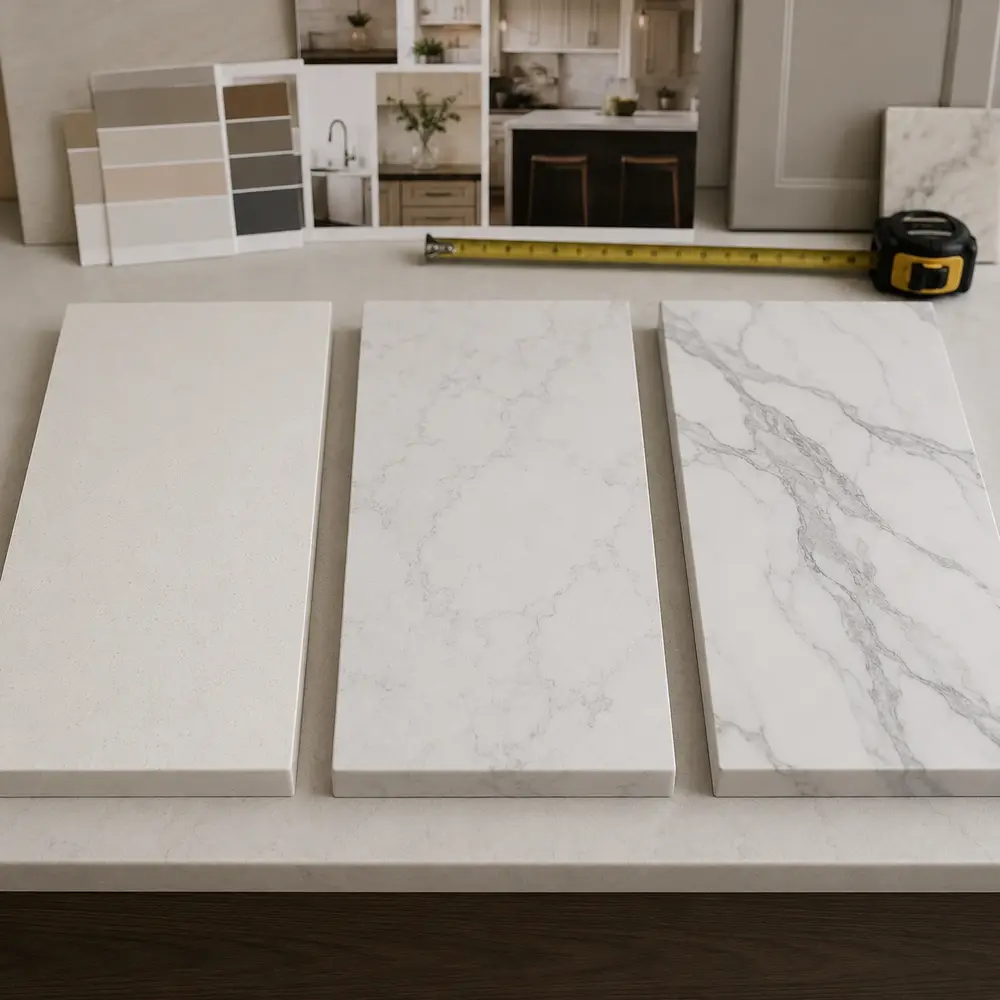
In 2026, quartz countertops run $60 to $150 per square foot fully installed in Chicago, with most residential kitchens landing between $85 and $120/sq ft for a mid-grade slab. For context, a standard kitchen with 30 square feet of countertop surface typically costs $3,500 to $7,500 all-in, including material, fabrication, delivery, and installation.
Here is the full tier breakdown:
| Tier | Material Only | Installed — Chicago |
|---|---|---|
| Entry-level | $25–$45/sq ft | $60–$85/sq ft |
| Mid-grade | $45–$75/sq ft | $85–$120/sq ft |
| Premium / Designer | $75–$120/sq ft | $120–$150/sq ft |
A few things are worth understanding before you compare quotes. Material is only 40–50% of what you pay. Fabrication — the cutting, edge polishing, and seam work — accounts for 30–40%, and installation itself adds another 10–20%. That means a $50/sq ft slab can turn into a $90/sq ft installed quote by the time fabrication and delivery are included.
Chicago prices also run slightly above the national average, which sits at $75–$125/sq ft for a mid-grade install. Urban logistics, higher labor rates, and the cost of operating a local showroom all push Chicagoland quotes a bit higher than, say, a suburban Wisconsin fabricator.
What Factors Drive the Final Price?
Five variables account for nearly every dollar of difference between a $60/sq ft quote and a $150/sq ft quote. Understanding them means you can evaluate any quote line by line instead of just comparing bottom-line totals.
1. Slab Tier and Brand
Brand choice has the single biggest impact on material cost. Entry-level slabs from manufacturers like MSI Q and Silestone base collections often sit in the $25–$45/sq ft range. Mid-grade options from Cambria, Silestone, and Caesarstone sit in the $45–$75/sq ft range. Premium and designer collections can push to $75–$120/sq ft or higher.
| Brand | Installed Price Range — Chicago |
|---|---|
| MSI Q | $60–$90/sq ft |
| Silestone | $65–$130/sq ft |
| Cambria | $75–$140/sq ft |
| Dekton | $80–$140/sq ft |
| Caesarstone | $70–$130/sq ft |
2. Edge Profile
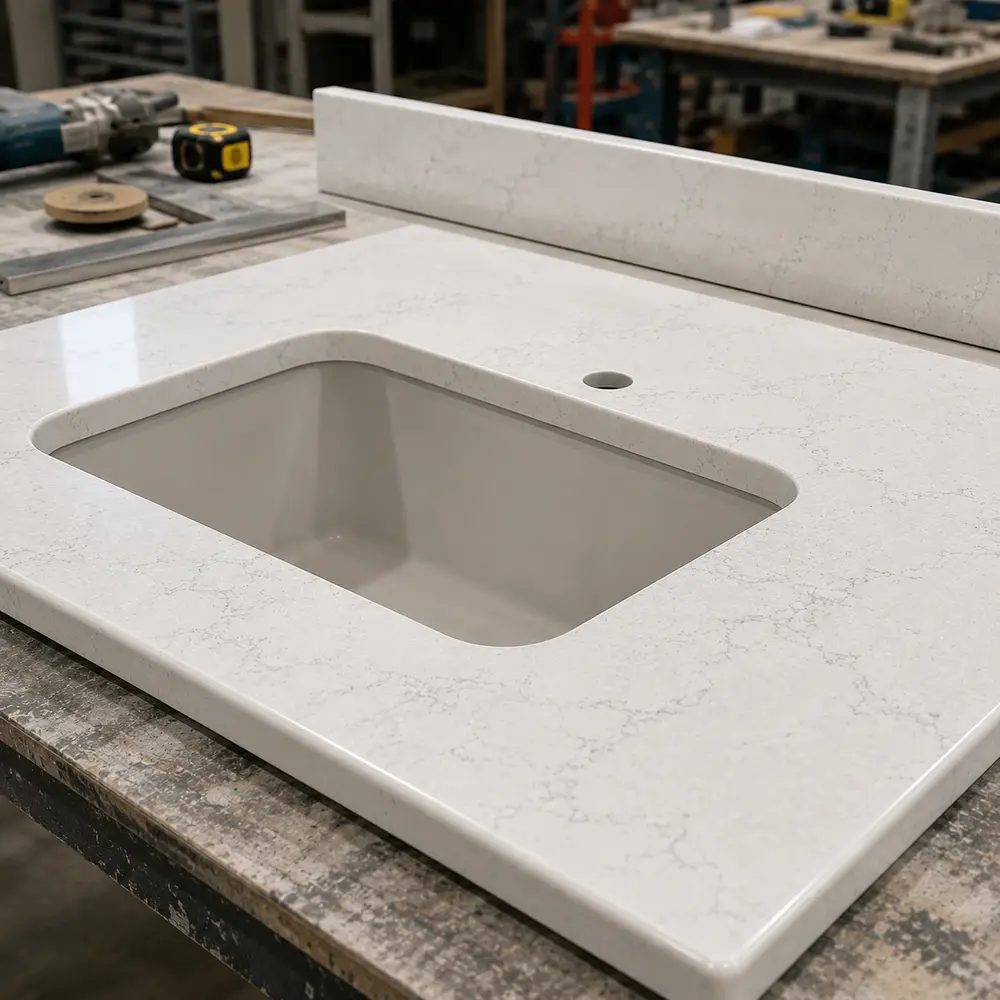
This is where quotes get sneaky. Most installers include a standard eased or beveled edge at no extra charge. The moment you upgrade to an ogee, waterfall, or mitered edge, you may be looking at $20–$50 per linear foot extra. On a kitchen with 20 linear feet of edge, that can add $400–$1,000 to the project.
In a Chicago fabrication shop, the waterfall edge is often one of the most requested upgrades for kitchen islands. It can look great, but it is also more labor-intensive to fabricate. At $40–$50/linear foot, a waterfall on both sides of a 10-foot island can add $800–$1,000 to a project.
3. Cutouts
Every opening cut into the slab costs money. Undermount sinks typically run $150–$300 per cutout. Faucet holes add $100–$200 each. A cooktop or range cutout can run $200–$400 depending on shape. A typical kitchen with an undermount sink, faucet, and side spray has three to four cutouts — adding $450–$1,200 before anything else.
4. Seams
L-shaped kitchens, island extensions, and wraparound counters all require seams where two slabs meet. Each seam means additional templating, precise cuts, and color-matched adhesive work. Budget $50–$200 per seam for the labor.
5. Backsplash
If you want a matching quartz backsplash — a popular choice in 2026 — expect to add $15–$40 per linear foot on top of the countertop price. For a 10-foot backsplash run, that is $150–$400.
What Each Upgrade Adds to Your Project
Average cost per unit — Chicago 2026:
| Upgrade | Typical Cost Range | Common Pricing Unit |
|---|---|---|
| Sink Cutout | $150–$300 | Per cutout |
| Upgraded Edge | $20–$50 | Per linear foot |
| Faucet Hole | $100–$200 | Per hole |
| Backsplash | $15–$40 | Per linear foot |
| Seam Joint | $50–$150 | Per seam |
Entry-Level Quartz Countertops — What Should You Expect?
Entry-level quartz delivers on the core promise of the material. At $60–$85/sq ft installed, you are getting a durable, easy-to-clean surface that can last for decades. What you are not getting is maximum design flexibility.
Here is the honest breakdown of what entry-level means:
What you get:
- Solid, non-porous surface
- 10–15 year warranty from many manufacturers
- A reasonable selection of neutral colors, including whites, grays, and light beiges
- Standard slab options for straightforward kitchens
What you give up:
- Wider color and pattern range
- Book-matched veining and bolder designer patterns
- Premium edge profiles included in the base price
- Some brand-name recognition that may matter at resale
Where does entry-level quartz shine? Rental properties, laundry rooms, basement bars, secondary bathrooms, and investment properties where durability matters more than a high-end visual statement. If you are renovating to sell in 12–18 months, mid-grade is usually worth the step up.
Warning signs of a quote that is too cheap: If someone is quoting less than $55/sq ft installed in Chicago, ask exactly what is included. Very low quotes often omit the template fee, delivery, or haul-away of the old countertop — costs that show up as add-ons at the end of the job.
How Chicago Prices Compare to the National Average
Chicago installation labor often runs above national averages because of higher labor rates, urban delivery logistics, parking limitations, building access rules, and the cost of operating a showroom in a dense metro market. For a 30 sq ft kitchen, labor alone can account for several hundred dollars to more than $1,000 depending on access, layout, and project complexity.
What most cost guides do not tell you is that where in Chicagoland you live matters. Countertop projects in Lincoln Park, River North, and the Gold Coast can run 10–15% above the same project in suburban Schaumburg, Naperville, or Orland Park. Urban Chicago installers face higher overhead — parking, delivery access restrictions, building management coordination — and pass some of those costs on. If you are in the suburbs, use Chicago pricing guides as a ceiling, not an average.
| Area | Typical Installed Range | Notes |
|---|---|---|
| Urban Chicago — Lincoln Park, River North | $90–$150/sq ft | Higher delivery and access overhead |
| Chicago proper — North and South sides | $80–$135/sq ft | Standard metro rates |
| Near suburbs — Evanston, Oak Park | $75–$125/sq ft | Moderate overhead |
| Outer suburbs — Naperville, Schaumburg | $65–$110/sq ft | Lower logistical costs |
What a complete Chicago quote covers: A well-itemized quote should include template measurement, material or slab cost, fabrication, cutting, polishing, edge work, delivery, installation, and haul-away of the old countertop. If any of those are not listed, ask before you sign.
Timeline to expect: From the first measurement visit to completed installation in Chicagoland, the typical timeline is 1–3 weeks. This usually breaks down as template visit, approval, 5–10 business days for fabrication, and installation day. If you are working with an in-stock slab, some shops can compress this to 5–7 business days.
Quartz Installed Cost: Chicago vs. National Average
Price per square foot by tier — 2026:
| Tier | Chicago Mid-Range | National Mid-Range |
|---|---|---|
| Entry | $73/sq ft | $65/sq ft |
| Mid-grade | $103/sq ft | $90/sq ft |
| Premium | $135/sq ft | $112/sq ft |
Quartz vs. Granite vs. Porcelain — Which Is Worth It in Chicago?
Quartz is one of the most popular countertop materials because it offers a strong mix of durability, design consistency, and low maintenance. But popularity does not mean it is the right choice for every kitchen. Here is where each material wins.
Quartz vs. Granite
At mid-grade, these two are closer in price than most people expect. Quartz runs $85–$120/sq ft installed, while many granite projects fall around $90–$140/sq ft. In some standard kitchens, the total difference may be smaller than expected.
The real gap is in what you do after installation. Quartz requires no sealing. Granite usually needs resealing over time, depending on the stone, finish, use level, and sealer quality. Quartz also gives homeowners more predictable color and pattern consistency, while granite offers natural variation from slab to slab.
Where granite wins is heat resistance. Granite handles heat better than quartz. Quartz can be damaged by direct high heat, so trivets are still important. If you cook heavily and often set hot pots directly on the counter, granite may be worth considering.
Quartz vs. Porcelain
Porcelain countertop slabs are gaining attention in Chicago kitchens. They are UV-resistant, which makes them useful for outdoor kitchens and spaces with direct sunlight. Typical installed cost often overlaps with mid-grade and premium quartz.
Porcelain is thinner than most quartz slabs, which gives it a sleek and modern profile. The trade-off is a higher risk of edge chipping if impacted, and fewer local fabricators who work with it regularly. That can affect lead times, cost, and final installation quality.
Which Adds Most Resale Value in Chicago?
Quartz and granite are still the top two picks that many Chicago real estate professionals recognize for kitchen appeal. Porcelain is gaining traction in luxury new builds, but it has not yet reached the mainstream resale recognition of quartz and granite.
Material Comparison: Quartz vs. Granite vs. Porcelain
Scored 1–5 across five key criteria, where 5 means strongest:
| Criteria | Quartz | Granite | Porcelain |
|---|---|---|---|
| Cost Value | 3 | 3 | 4 |
| Durability | 5 | 4 | 4 |
| Low Maintenance | 5 | 2 | 5 |
| Heat Resistance | 2 | 5 | 5 |
| Resale Value | 5 | 5 | 3 |
How to Read a Chicago Countertop Quote
A fair Chicago countertop quote should list material, fabrication, delivery, and installation as separate line items — never lumped into a single installed price with no breakdown. When those four components are transparent, you can compare two quotes for the same slab side by side.
Here is what each line should look like in a fair Chicago quote:
| Line Item | Fair Range — Chicago 2026 |
|---|---|
| Slab material | $25–$120/sq ft |
| Template / measurement visit | $150–$300 one-time |
| Fabrication and edge work | $20–$40/sq ft |
| Delivery | $100–$300 |
| Installation and mounting | $5–$15/sq ft |
| Haul-away of old countertop | $75–$200 |
| Cutouts | $100–$300 each |
Questions to ask every installer before signing:
- Is the template fee included, or is it extra?
- What edge profile is included at the base price, and what do upgrades cost?
- How many cutouts are in the quote, and what is the cost for each?
- Does the quote include haul-away of my existing countertop?
- What is the fabrication lead time right now?
So how do you compare two quotes for the same slab? Strip out the material cost and compare just the fabrication, labor, and delivery total. On a 30 sq ft kitchen, that service component should usually land between $1,200 and $2,500 for a fair Chicago quote. Anything above $3,000 for service only deserves a direct question.

Where to Buy Quartz Countertops in Chicago
Chicago has three main buying channels for quartz countertops, and each comes with a different price point, lead time, and level of service. Knowing the trade-offs saves you time and money.
1. Local Chicago Showrooms
Best for: Custom projects, full-service support, wide slab selection, and local accountability.
A local showroom gives you access to more slab options, not just small catalog samples. You can see veining, color variation, and thickness in person before committing. Fabrication is typically done in-house or by a closely managed partner shop, and you have a single point of contact for the entire project. Lead times often run 1–3 weeks.
This is the right choice for most kitchen projects over 25 square feet, custom islands, or anything involving complex edges or seams.
2. Big-Box Retailers
Best for: Budget projects, fast decisions, and basic slabs.
You will usually find a more limited color selection and more standardized options. Lead times can run longer depending on availability. The service experience tends to be less personalized, and fabrication is often subcontracted, meaning quality control may vary more. That said, big-box pricing can be competitive for entry-level slabs in basic colors.
3. Online Slab Marketplaces
Best for: Homeowners who want to hand-pick material before a local fabricator installs it.
Online slab marketplaces let you browse and compare slabs digitally. If you are particular about veining patterns or want to source a specific color, this adds a step but gives you more control. You will still need a local Chicago fabricator for the actual installation.
Bottom line: For most Chicago homeowners doing a full kitchen remodel, a local showroom is the best value equation. You get full-service accountability, in-person slab selection, and a project manager who knows the local market.
Frequently Asked Questions
How much does quartz countertop installation cost in Chicago in 2026?
In 2026, quartz countertops cost $60 to $150 per square foot installed in Chicago. A standard kitchen with 30 square feet of countertop surface typically runs $3,500 to $7,500 all-in, including material, fabrication, delivery, and installation. Urban Chicago neighborhoods can run higher than outer-suburb pricing.
What is the cheapest quartz countertop option in Chicago?
Entry-level quartz starts around $60/sq ft installed in Chicago. Common entry-level options usually come in neutral whites, grays, and creams. You get the same low-maintenance surface as premium quartz, but with fewer color options and standard edge profiles.
Is quartz cheaper than granite in Chicago?
At mid-grade, the difference is often smaller than people expect. Quartz commonly runs $85–$120/sq ft installed, while many granite projects sit around $90–$140/sq ft. Where quartz can win long-term is maintenance, since it does not require regular sealing.
How long does quartz countertop installation take?
From the template measurement visit to completed installation, most Chicago projects take 1–3 weeks. The timeline is usually template visit, approval, 5–10 business days of fabrication, and installation day. If the slab is in stock and the kitchen layout is straightforward, some shops can move faster.
Does quartz countertop installation add value to a Chicago home?
Yes. Quartz is widely recognized as a desirable kitchen surface because it is durable, low-maintenance, and visually versatile. In many Chicago homes, quartz and granite remain two of the strongest countertop options for resale appeal.
The Bottom Line
Here is what this guide comes down to:
- Entry-level quartz in Chicago: $60–$85/sq ft installed — durable, low-maintenance, limited in design range.
- Mid-grade quartz: $85–$120/sq ft — the sweet spot for most Chicago kitchen remodels.
- Premium/designer quartz: $120–$150/sq ft — maximum design flexibility and stronger brand-name recognition.
- Total kitchen project: $3,500–$7,500 for a standard 30 sq ft kitchen all-in.
- Biggest hidden cost drivers: edge upgrades, cutouts, and backsplash add-ons.
- Chicago vs. national: Expect urban projects to run higher; suburbs often track closer to national ranges.
Quartz is popular for good reason. It is durable, it does not need sealing, and it works in many kitchen styles. Whether you are at the entry level or going custom, the key is understanding the quote you are looking at — and knowing what is fair.
Ready to see slabs in person? Contact Chicago Countertop Co. to request a free countertop quote or visit our showroom. We measure, fabricate, and install throughout Chicagoland with transparent pricing and no surprise add-ons.
Sources
- HomeWyse, Cost to Install Quartz Countertop
- Fixr, How Much Do Quartz Countertops Cost?
- SlabWise, Countertop Pricing by Material Guide
- SlabWise, Quartz vs Granite Countertops Comparison
- BuildX, Install Quartz Countertop Cost in Chicago, IL
- ContractorPlus, Cost to Install Quartz Countertops in Chicago IL
- Cognitive Market Research, Quartz Countertops Market Analysis
- NKBA, Kitchen Design Trends
- Homeguide, Quartz vs. Granite Countertops Comparison Guide
- DGFloors, Quartz Countertops Cost Guide
- Granite Selection, How Much Do Quartz Countertops Cost in Chicago?
One Response
[…] square footage, fabrication, edge work, cutouts, and site conditions. Our granite cost guide and quartz cost guide give current Chicago-area […]