

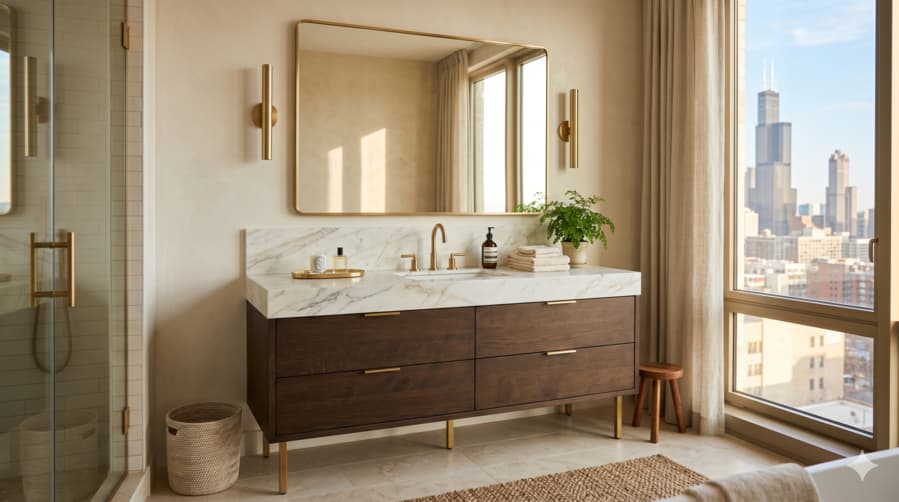
Bathroom Design Guide
Your bathroom vanity gets used every single day — and it lives in the most humid room in the house. Here’s how to choose a countertop material that handles Chicago bathrooms beautifully, from busy family baths to spa-style master suites.
Most countertop advice is written for kitchens. But a bathroom vanity is a very different surface with very different demands. It’s smaller, so the slab itself matters more visually. It sees constant moisture, standing water around the faucet, and a daily rotation of products that stain and etch — toothpaste, makeup, perfume, hairspray, nail polish remover, and harsh cleaners. And in a powder room or master bath, the vanity is often the design centerpiece, not a workhorse hidden behind appliances.
The good news: because bathroom vanities are smaller than kitchen counters, you can often afford a more striking, higher-end material than you’d budget for a full kitchen. A dramatic slab that would be a major investment across a large kitchen becomes very achievable on a single vanity top.
At Chicago Countertop Co., we fabricate and install vanity tops for homeowners across Chicago and the surrounding suburbs — Naperville, Oak Brook, Hinsdale, Schaumburg, Evanston, Barrington, and beyond. Below is how the most popular materials actually perform in a bathroom, so you can match the surface to how your space is used.
What actually matters in a bathroom (it’s not the same as a kitchen)
Before comparing materials, it helps to know what you’re really optimizing for. Heat resistance — the headline feature for kitchen counters — barely matters at a vanity. Instead, the priorities shift:
- Moisture and water resistance. Bathrooms stay humid, and water pools around faucets and sink cutouts. Porous stones need proper sealing to avoid dark water marks over time.
- Stain and chemical resistance. Bathroom products are surprisingly aggressive. Many cosmetics, cleaners, and toiletries are acidic or pigmented enough to etch or stain a vulnerable surface.
- Low, easy maintenance. A vanity should look good with a quick daily wipe — not a sealing schedule you have to remember.
- Visual impact. Because the surface is small, every bit of veining and movement shows. The slab is the star.
With that lens, here are the five materials we recommend most often for Chicago vanities.
1. Quartz — the easy, worry-free favorite
Best for: family bathrooms, kids’ baths, and anyone who wants zero maintenance.
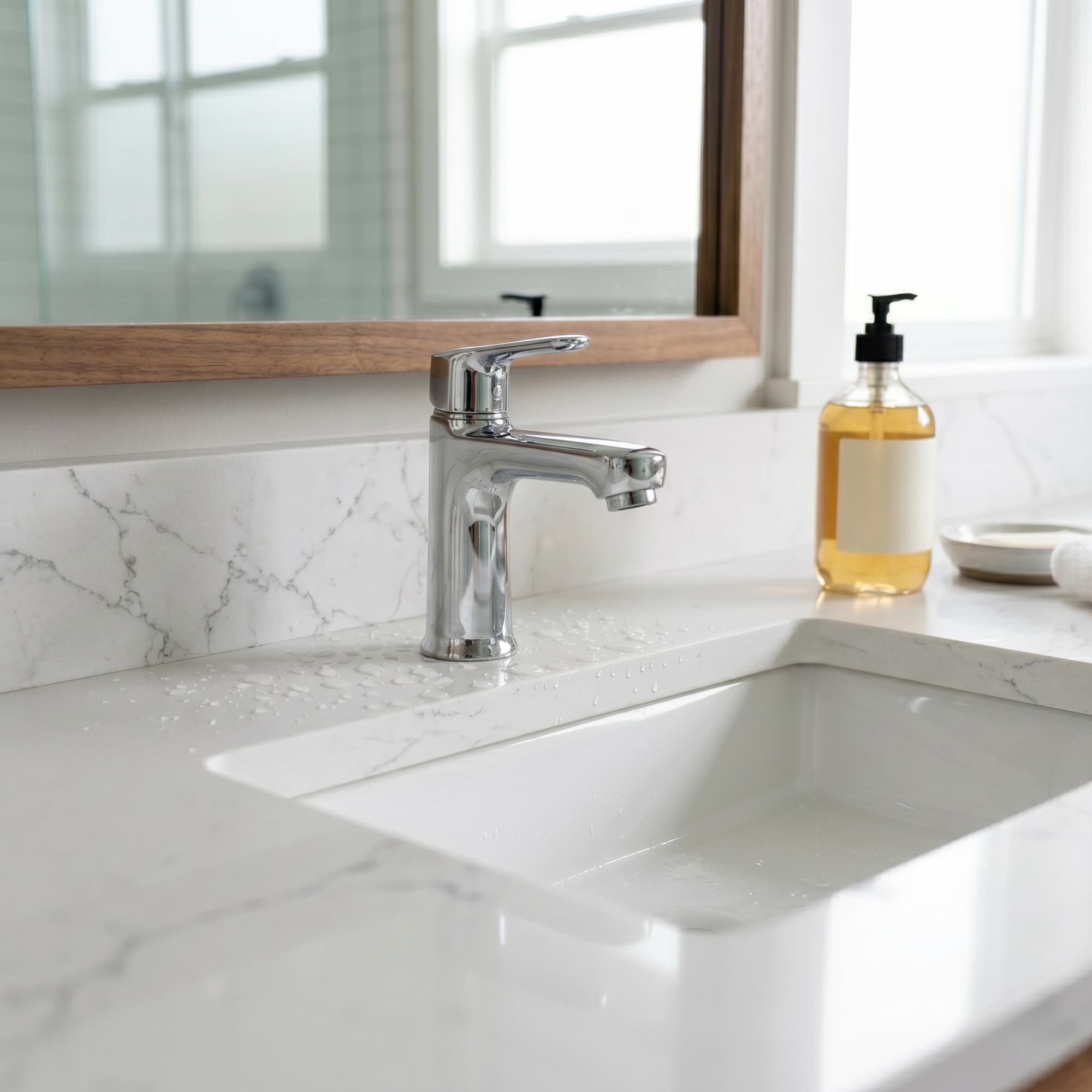
Engineered quartz is the surface we recommend most often for bathrooms, and the reason is simple: it’s non-porous. Because it doesn’t absorb water, it never needs sealing and shrugs off the moisture that defines a bathroom. It resists stains from toothpaste, makeup, and most everyday products, and it cleans up with mild soap and water.
Quartz also comes in the widest range of consistent colors and patterns — from clean solid whites to convincing marble-look veining — so you can get the look of natural stone without the upkeep. For a hardworking family or kids’ bathroom, it’s hard to beat.
STRENGTHS: Non-porous and never needs sealing • Excellent stain and moisture resistance • Huge range of colors and marble-look patterns • Effortless daily cleaning.
KEEP IN MIND: Patterns are more uniform than true natural stone • Not ideal for sun-flooded windows with heavy direct UV.
2. Granite — natural durability that handles daily use
Best for: high-traffic bathrooms and homeowners who want a one-of-a-kind natural stone.
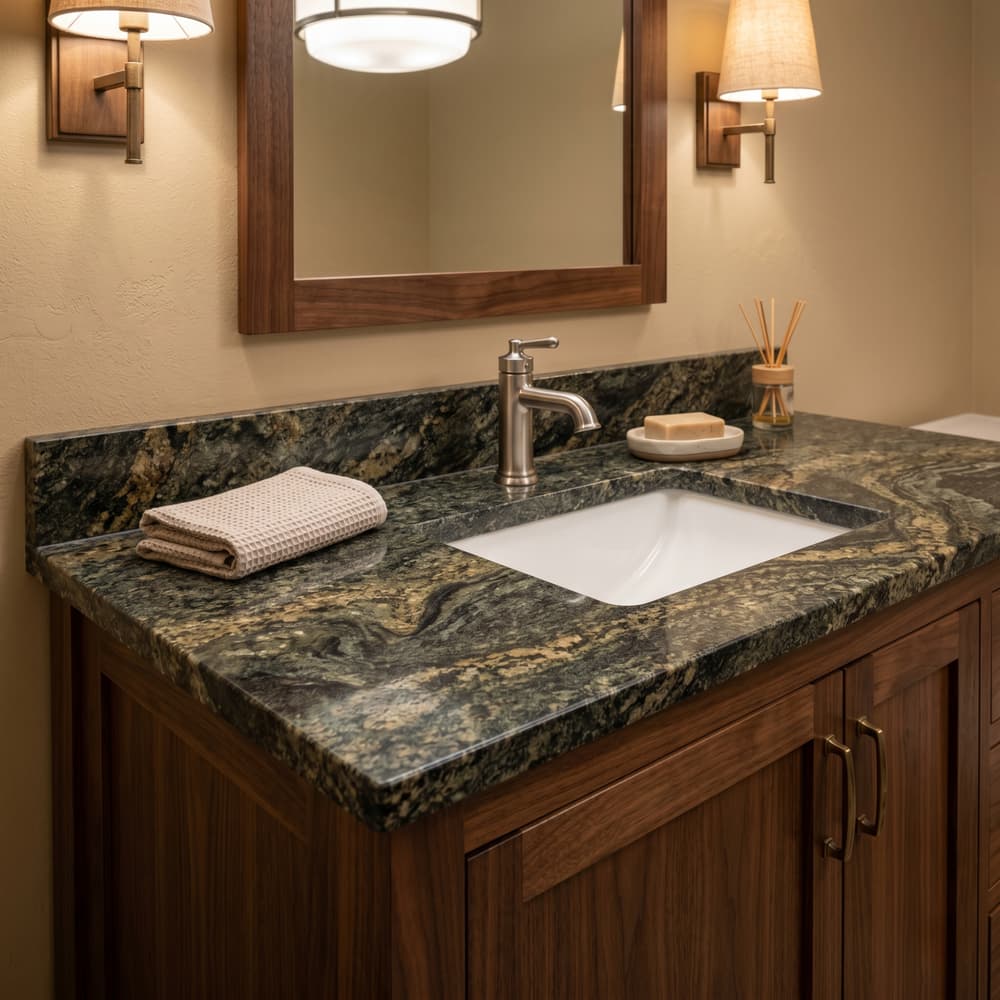
Granite is a natural stone that’s exceptionally hard and, once properly sealed, very resistant to moisture and staining — which makes it a dependable choice for a bathroom that gets real use. Every slab is unique, so your vanity will have grain and movement no one else has.
The main consideration is sealing. Granite is naturally porous, so it should be sealed at installation and periodically refreshed. In a bathroom this is straightforward, but it’s a small ongoing task to plan for. The payoff is a tough, long-lasting surface with genuine natural character.
STRENGTHS: Extremely durable and scratch-resistant • Each slab is one-of-a-kind • Excellent moisture resistance once sealed.
KEEP IN MIND: Needs periodic resealing • Bold patterns can be busy in a small space.
3. Marble — timeless luxury for the spa-style bath
Best for: master bathrooms, powder rooms, and statement vanities where elegance leads.
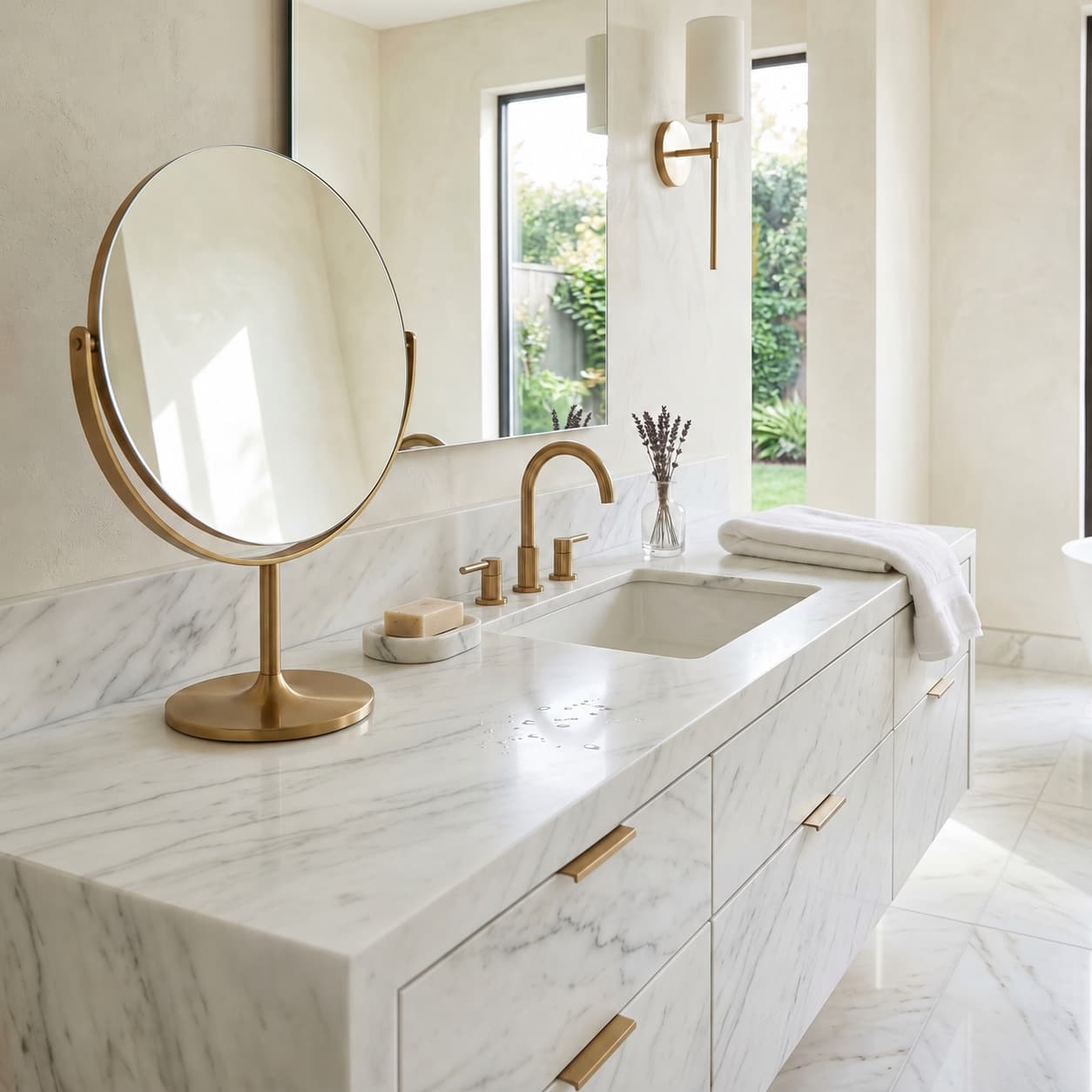
Nothing says luxury bathroom quite like marble. Its soft, flowing veining and cool, smooth surface have defined high-end bathrooms for centuries, and a marble vanity reads instantly elegant. Here’s where marble shines compared to the kitchen: a bathroom vanity sees far less abuse than a kitchen counter, so marble’s main weaknesses are much easier to live with.
That said, marble is softer and more porous than the other options, and it’s sensitive to acidic products — perfume, certain cleaners, and some cosmetics can leave dull “etch” marks. Many homeowners love the lived-in patina that develops over time; others prefer to keep it pristine with sealing and careful product habits. For a low-traffic powder room or a master bath you treat with care, marble delivers a look nothing else matches.
STRENGTHS: Unmatched classic elegance and veining • Cool, smooth surface • Lower abuse in a bath than in a kitchen.
KEEP IN MIND: Softer — can scratch and etch from acids • Porous and needs sealing • Best in low-traffic or carefully maintained baths.
4. Quartzite — the marble look, built tougher
Best for: homeowners who want marble’s drama with much more durability.
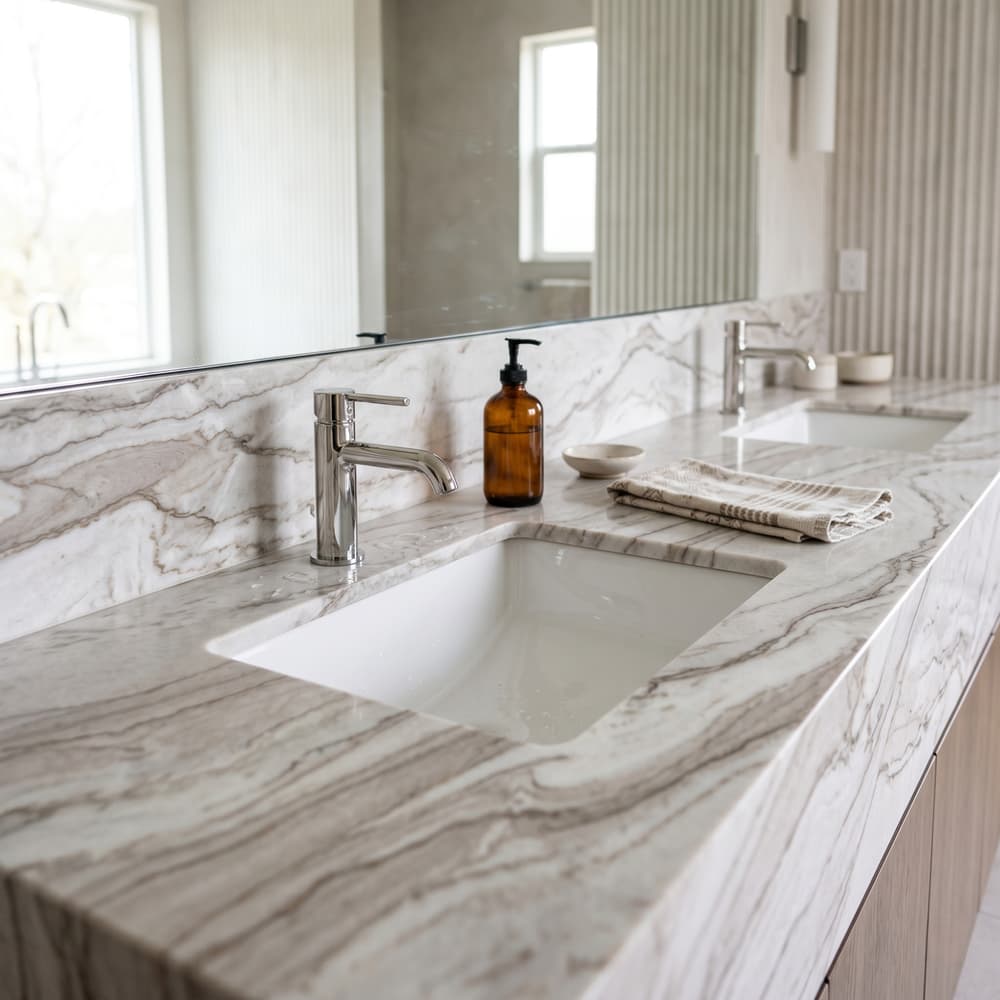
Quartzite is the natural stone that gives you the best of both worlds in a bathroom. It offers the dramatic, marble-like veining many homeowners want, but it’s a genuinely hard natural stone — significantly more scratch- and etch-resistant than marble. For a Chicago homeowner who falls in love with a marble look but worries about upkeep, quartzite is often the answer.
Like other natural stones it should be sealed, but it stands up to daily bathroom life better than marble does. It’s become one of the most requested luxury surfaces in the area, and a vanity is a perfect place to use a striking quartzite slab.
STRENGTHS: Marble-like beauty with far greater hardness • Strong scratch and etch resistance • Distinctive natural veining.
KEEP IN MIND: Still a natural stone — should be sealed • Premium material, pricing reflects that.
5. Porcelain — thin, modern, and ultra-low-maintenance
Best for: contemporary bathrooms, floating vanities, and large-format minimalist looks.
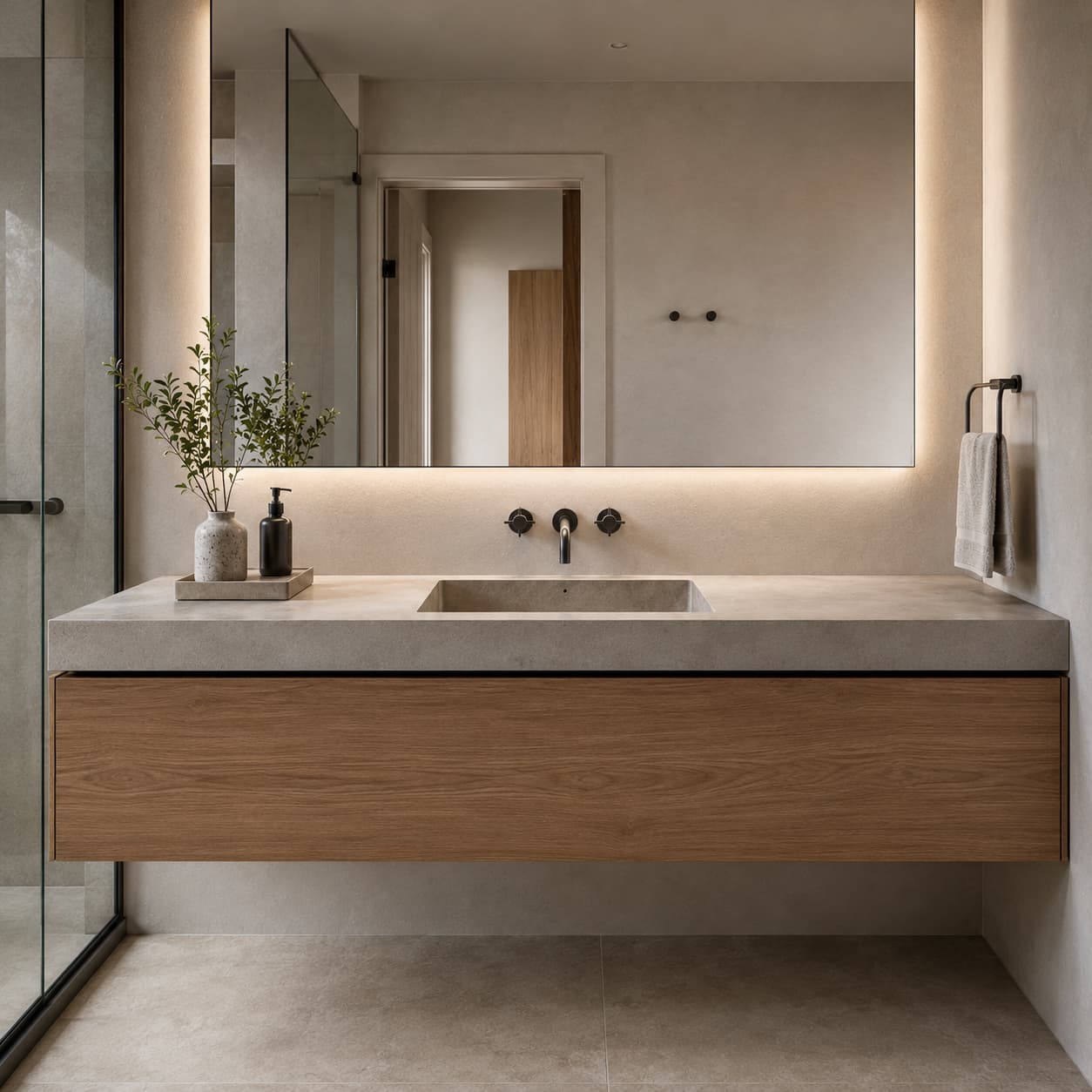
Porcelain is the newest option on this list and a great fit for modern, minimalist bathrooms. It’s non-porous, highly resistant to stains, moisture, and scratching, and never needs sealing. It can be made in large-format slabs and in thinner profiles than natural stone, which suits sleek floating vanities and clean, contemporary designs. It also comes in convincing stone-look and solid-color finishes.
Because porcelain is a specialized material to fabricate and handle, it’s worth working with a fabricator experienced in it. For the right modern aesthetic, it’s one of the most practical surfaces you can choose.
STRENGTHS: Non-porous with no sealing required • Excellent stain, moisture, and scratch resistance • Thin, large-format options for modern looks.
KEEP IN MIND: Requires an experienced fabricator • Fewer veining patterns than natural stone, though improving.
Quick comparison at a glance
| Material | Maintenance | Sealing | Best fit |
|---|---|---|---|
| Quartz | Very low | Never | Family & kids’ baths |
| Granite | Low | Periodic | High-traffic baths |
| Marble | Higher | Yes | Powder & master baths |
| Quartzite | Low–moderate | Periodic | Luxury, durable look |
| Porcelain | Very low | Never | Modern, floating vanities |
A note on cost: bathroom vanities use far less material than kitchens, so the price difference between a budget-friendly surface and a premium statement slab is much smaller here than it would be across a full kitchen. We’ll break down vanity pricing in detail in a dedicated cost guide — but the short version is that a vanity is the best place in your home to splurge on a slab you love.
How to choose the right one for your bathroom
Instead of asking which material is “best,” ask how your specific bathroom is used:
- Busy family or kids’ bathroom? Go with quartz or porcelain — non-porous, forgiving, and effortless to clean.
- Master bath you’ll treat with care? Marble or quartzite gives you that luxury-hotel feeling.
- Want a true one-of-a-kind natural stone? Granite or quartzite, where no two slabs are alike.
- Sleek, modern, floating-vanity look? Porcelain’s thin profiles and clean finishes are made for it.
- Powder room you want to wow guests? This is the spot for a dramatic marble or quartzite slab — small area, big impact.
Common questions from Chicago homeowners
Is marble a bad idea for a bathroom?
Not at all — bathroom vanities see far less wear than kitchen counters, so marble is much easier to live with here. The key is matching it to a low-traffic or carefully maintained space, and being mindful of acidic products like certain cleaners and cosmetics.
Which bathroom countertop needs the least maintenance?
Quartz and porcelain. Both are non-porous, never need sealing, and clean up with mild soap and water — ideal for busy households.
Do natural stone vanities need sealing?
Granite, marble, and quartzite are natural stones that should be sealed at installation and periodically refreshed. Quartz and porcelain are non-porous and never require sealing.
Can I use the same material as my kitchen?
You can, and many homeowners do for a cohesive look — but you don’t have to. A bathroom’s smaller scale means you can choose a more dramatic or premium slab than you might pick for a large kitchen.
See your vanity slab in person
Explore over 4,000 full-size slabs in our Chicago-area showroom, and let our team help you match the right material to how you actually use your bathroom — from selection through expert fabrication and installation.